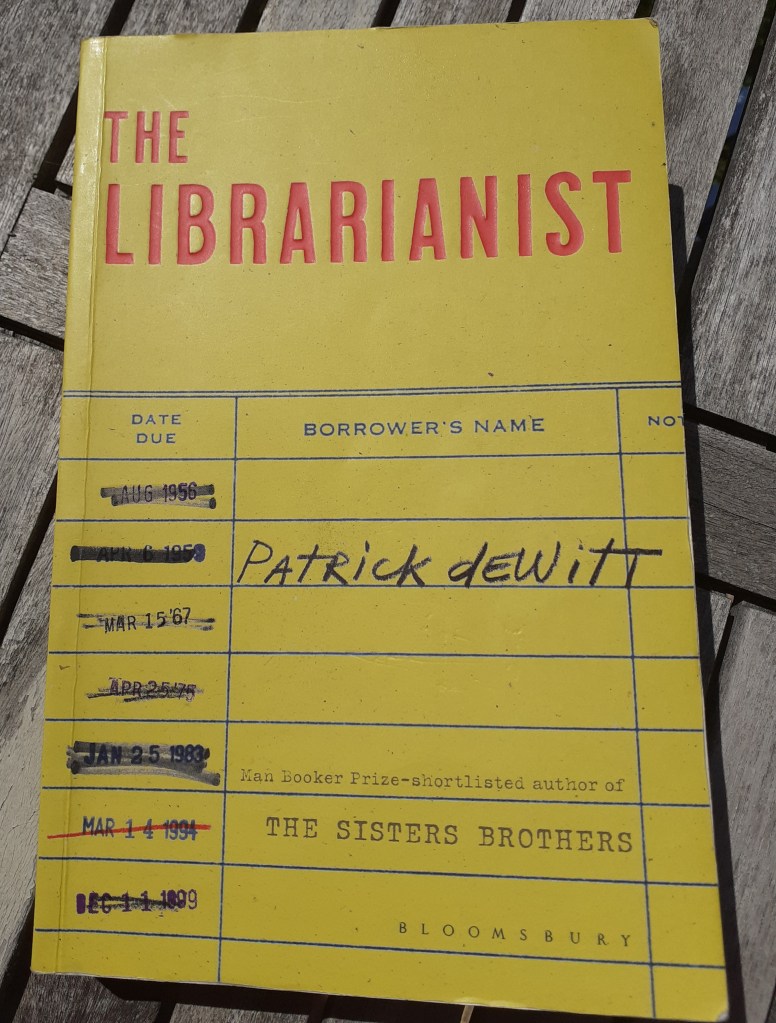
I absolutely loved the out-thereness of deWitt’s The Sisters Brothers, French Exit, and Undermajordomo Minor. With bonus points for cover art. Although the cover art is easily as wonderful, The Librarianist has a very different feel to it, as this story is less out-there and more barely-there.
The story is about Bob, the retired librarian(ist) from the title. Bob lived his life according to a strict schedule which existed of work, mainly, and not much of a personal life otherwise. Bob is the ultimate loner, spending his entire life in the same house. Routine is everything to him.
Then, on his daily one-mile walk, he finds an elderly woman lost, staring into the freezer of a corner shop. She is wearing a badge, so he returns her to the assisted-living home where she is registered, and this leads to Bob becoming a volunteer there.
The people at the home are quite the characters, which Bob isn’t, and they aren’t interested in him nor what he has to offer (book readings, starting with the great Russians).
Slowly but surely Bob’s past is revealed and it turns out that his loner-ship is a natural state of being. Bob was an only child, he didn’t know his father, and never had any friends.
That is, until he starts working at the local public library where he meets Ethan. Ethan is everything Bob is not: charismatic, dashing and outgoing.
The library is also where he meets his wife Connie. She is pretty and sociable; the yin to Bob’s yang. Bob grounds both Ethan and Connie, but their personalities need to fly and it’s not a spoiler to say that it doesn’t take long before Bob is a loner once again.
The things that happen to Bob, truly happen to him and he is never really active in anything. He’s the ultimate stoic: whatever happens, he just shrugs and trudges on.
The two exceptions to this are his decision to become a volunteer at the assisted-living home, and the time when as a kid he ran away from home. He got onto a bus and a train, heading for the Oregon coast. Halfway through the train trip, two traveling performers join him on the journey and accept him as a stowaway, but from then on out, he loses his momentum and decision-making skills: the ladies invite him to come along with them and he does. He doesn’t really make any choices any more, he just goes along with everything. If ever there was a follower, it was Bob. That his only real decisions took place at the beginning and near-end of his life are like bookends to the story of Bob, and totally fitting.
The beginning and end were the stronger parts for me, as I found the middle part a bit slow. I think if I re-read this, I might feel different about it, as it was mostly because I kept waiting for the part where things took a turn and went wild. And they just never did.
That’s not to say this isn’t a good story. It really is. It’s also funny, in a very dry way. It’s just very normal compared to the other work I’d read by this author, and I guess I wasn’t prepared for that. So let this be a warning for others: do not expect this book to be outrageous. This book is as calm and solid as its protagonist.

