First the flu, then pneumonia. It’s as if a virus doesn’t care that you have a reading challenge waiting.
The good news: I read two chapters over the weekend so things are moving in the right direction!
Reading challenge 2026 – No. 16: A debut
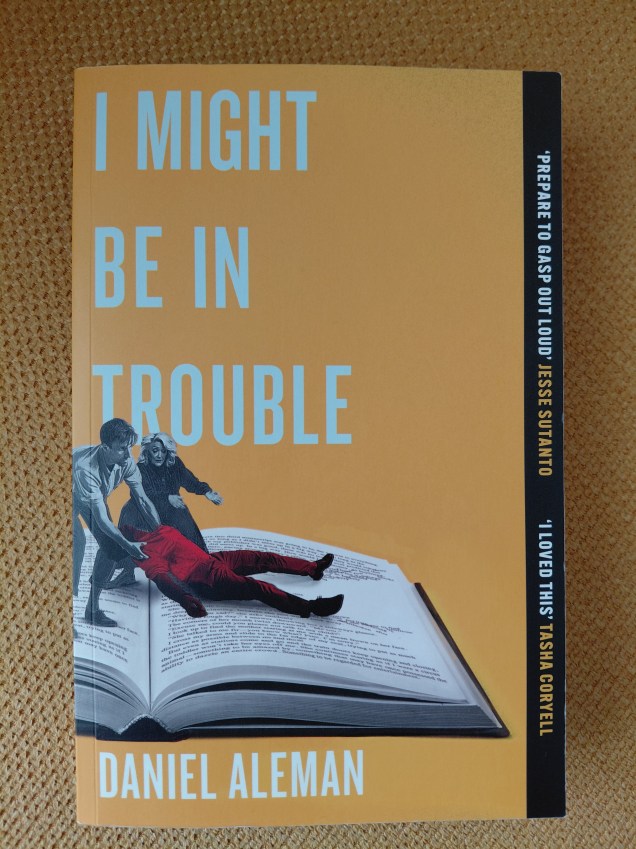
I might be in trouble / Daniel Aleman
What it is: a Matryoshka doll of a story
Did I like it: da
I found this book in the bookshop and even though I didn’t think it fit any category of the new reading challenge, I was too tempted and bought it anyway. Because I was desperate for it to fit a category, I checked the author and found out it’s registered as his debut adult novel, after having published two YA books. A debut is a debut, so here we are: first category of this year’s reading challenge checked! This category was suggested by GR via email. Thanks, GR, for making me discover a new author!
I might be in trouble is a darkly funny story about David, a struggling author who wakes up next to a dead body. It’s not any dead body, it’s that of the man he went out with the night before. It had been the best date in a long time and he had high hopes to develop a relationship but that’s all come to an abrupt ending. The obvious thing to do is call the police, but David spirals out of control, and instead calls his literary agent, Stacey. Stacey is a tough lady who had several of her husbands die on her, and she has edited several detectives and murder mysteries, so she knows stuff. And so, they decide to bring the man back to his hotel room, where he can be found by a maid.
High jinks commence but it’s not just an update of Weekend at Bernie’s if that’s what you’re thinking or fearing. Because, when David wonders out loud how he’ll ever get over what they’re doing, Stacey calmly suggests he writes a book about it. Although hesitant at first, David cannot focus on anything else and so he starts to write the story of twenty-something Daniel, who wakes up in bed next to a dead body.
Between the high jinks and the new book, the story dives into David’s personal life, focusing on the relationships with his family and his ex-boyfriend. This part of the story creates some much-needed character development but it also at times slows the story down. What drives the story more than anything is David’s anxiety, and although it was well-written, if you’re not an anxious person reading it, it takes away a lot of the tension.
The blurbs for this book had me go in with high expectations and for me, the story doesn’t quite meet up to those; it didn’t make me gasp out loud, and I don’t think it’s a thriller, page-turning or not. I do think the setup was solid and I found it to be an entertaining and fast read.
Reset
Flu season is here and I had a ticket. It left me unable to read or blog for a while, and now that I’ve returned to life, some settings of the blog appear to have changed and I cannot for the life of me remember what the letter type setting used to be; I only know that what I’m looking at right now, isn’t, well, right. Please, bear with, while I try to reset / decide on an alternative.
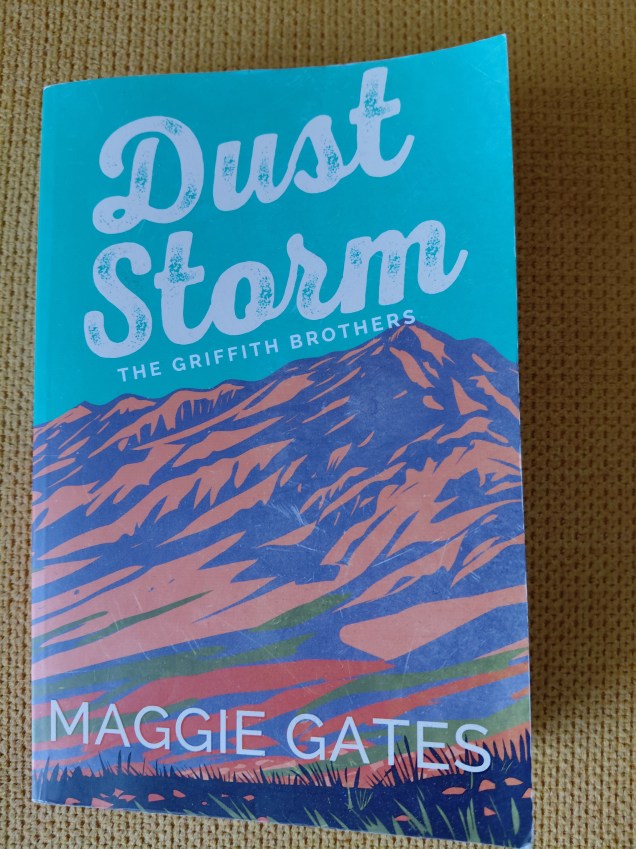
Book review : Dust storm / Maggie Gates
What it is: contemporary romance with a content warning
Did I like it: it wasn’t for me
For months I’ve been trying to remember when, where or why I bought this book. My best guess is a train station bookshop by lack of anything else from my wish list or within budget available because contemporary romance is not something I veer towards and the summary on the back isn’t the most intriguing. It turns out I can not only surprise or scare myself, but confuse myself as well.
But, as we all know, there is a time for every book and it came in handy during my first week of commuting to and from the new job. A new job comes with a lot of new information to process and a light and fluffy read during the commute allowed me to give my brain some much-earned rest to compensate.
The book starts by warning the reader about the adult content (something I had never seen before) and it wasn’t for nothing because this story contains a plenty of that, so I’m following up with a warning of my own: if that’s not your jam, don’t bother with this book.
Ignoring the language part, the story was..hm, sort of okay. It contains multiple tropes from the romanceverse: opposites attract, grumpy-vs-sunshine, and fish out of water.
Main characters, and telling the story in present tense in alternate chapters, are Christian and Cassandra. Cassandra has a type A personality, lives in New York City where she enjoys a high-flying career in publicity that includes mingling with celebrities and fashion designers. An incident sees her demoted to working corporate accounts only, starting with a cattle ranch in Texas. Her boss, who is also her fiancé, drops her off on the ranch before he flies off to Spain to take over her former client. Messy.
The ranch belongs to the Griffith family, and super mellow Christian is its general manager. He is a widower and father of two young girls, and doesn’t hold back on his opinions (even though he doesn’t like it when people tell him theirs). Within two minutes of meeting, he tells Cassandra that her fiancé is an idiot and she should dump him. Thinking that is one thing, but to basically tell someone you literally met minutes ago and don’t know at all, that they are making bad life decisions is pretty rude. And it doesn’t stop there; Christian is also absolutely adamant that a woman riding in his car is not allowed to open the doors herself. On multiple occasions he makes his daughters and Cassandra go back in the car, shuts the door on them, and then makes them wait for him to open it. It’s probably well-meant but it made me itch as it read more about dominating women to me than chivalry.
As the trope predicts, Cassandra is a fiercely independent woman who doesn’t like being told what she can or cannot do. Cassandra doesn’t like people, especially children, nor pets. So, moving into the house with Christian, his daughters, dog and pet cow, because the guest house is flooded, is her personal nightmare.
Christian doesn’t like the way Cassandra talks to his daughters (as if they are adults), even though the children find it refreshing and like her for it. Cassandra, the daughters, and I were annoyed by Christian’s closed-mindedness.
The story has something to do with future proofing the ranch but it’s mostly about how Cassandra and Christian are opposites that attract.
It seemed that Cassandra was the one doing the growing, as she was also the fish out of water, and Christian tended to be a bit of a bully with her which is why I didn’t like him. Then there was a big incident involving one of Christian’s brothers which causes him to break down, revealing some unexpected and oddly timed (too close to the end of the story) revelations about his personality. The incident with his brother is also something that kicks off another book and I wonder about the timelines of these stories, where and how they overlap. (Although I’m not curious enough to consider reading it.) Then to add to the oddness, the epilogue is in two parts as well, one from each of their perspectives, taking place eleven years later. It was such a big jump in time and it didn’t really add anything for me. Especially with romance novels I always question the use of epilogues anyway, because if one thing is for certain, it’s that there is a happily-ever-after.
All in all this book was okay enough to keep me entertained on days that I didn’t have enough brain cells available for anything else. If you like reading spicy contemporary romance this might be just for you (and if so, don’t forget to check out the other titles in the series), but for me, the kids and animals were the best parts of the story and I was keen to move onto something new as soon as I finished the last page.
Book review: Rare singles / Benjamin Myers
What it is: a story with a lot of soul
Did I like it: oh yeah
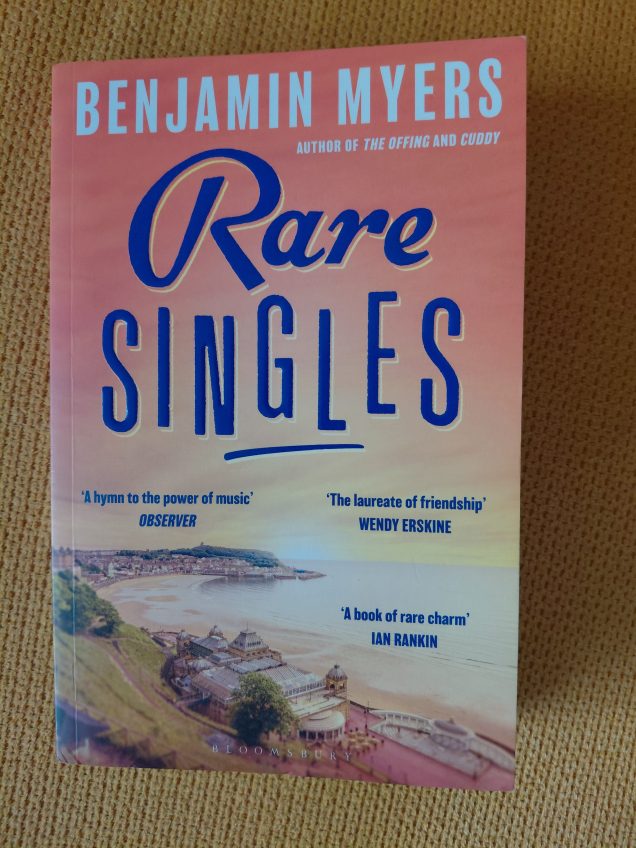
This is the last book I started last year, as part of the 2025 reading challenge due to the blue letters of the title. It doesn’t count anymore, so it’s just a review now.
I had bought this book specifically for the reading challenge and I recognized Scarborough on the cover. Then I realized I had read another book by this author, The Offing, which I remember as a very quiet story about self-discovery and growth. This book is different, yet there are comparisons that can be made: there are two main characters with a big age difference, it’s about self-discovery and growth as well, and both stories are set on the Yorkshire coast.
Rare Singles is set in Scarborough where Dinah is living her not-so-best life. She works as a checkout lady, is deeply unhappy about her personal life, and only cares about the weekends when she gets to enjoy soul music at a local club, as part of the Northern soul scene. She’s a massive fan of Bucky Bronco and asks him to travel to England and perform at the club for the last soul weekend of the season.
Bucky Bronco lives in Chicago where he is surviving, just about, and not exactly living. His wife has passed away and all he is left with, is a crippling addiction. When he receives an invite to do the show at a club in Scarborough, he’s stunned to discover people not only remember him, but still love the one song that he had released five decades before. He decides he has nothing to loose, and gets himself on a plane to England.
Bucky has never travelled outside the US and his musings about northern England are fun to read. Just like Dinah and Bucky, Scarborough’s glory days are a thing of the past and the setting felt like a proper third main character to me, especially the way it is seen through Bucky’s eyes.
The story is set in just a few days, but covers a lifetime. I really enjoyed Bucky as a main character, he is the star attraction in more than one way, and Dinah is his loyal second-in-command. There are discoveries made, mostly about personal growth and development, and I think this story can easily be made into a movie. (Actually, it totally should! The soundtrack would be awesome.)
At just over 200 pages this is not a big read at all so even if you don’t like big books, or want to travel light, book-wise, this comes highly recommended!
Keep on reading
May the books you read be plentiful,
and their stories wonderful.
May they offer a laugh, or a tear, or an escape from reality.
May they offer you exactly what you need and more.
Happy new year, happy new reading!
Reading challenge 2026
Back in early November I invited you to provide me with entries for the Reading challenge 2026, and gosh, did you come through! This list was compiled with contributions from: friends C, E, E2, M, Patsy D, GR, Reader123, Stef100, JJReads, along with two items from myself.
Happy reading wishes for the New Year!
- A book you saw someone else read in public
- A book with a cover you DON’T like
- A book where numbers outwit humans
- A book wherein friendships flourish after a disaster
- A book in which the dog is wiser than all the humans
- A book that sees coffee solves more problems than therapy. (Bonus points if everyone ends up lost or blissfully caffeinated somewhere in Portugal)
- A book based on a TED talk or vice versa
- A book in dialect or different language
- A book read by your parents
- A book with the name of the month in the title to read during that month
- A book with your birthday month in the title
- A book with two words in the title that start with the letter L
- A book with a purple cover
- A book with a profession in the title
- A book about an animal
- A debut
- A book with chapter titles
- A historical fiction that is not WWII
- The author has an alliteration name
- A Booktok recommendation
- A book on display at the library
- A book inspired by the last song you listened to
- A book that is set on two different continents
- A book you read on vacation
- A book that features a bar

Reading challenge 2025 – No. 24 : The protagonist has the same job as me
The librarian of burned books / Brianna Labuskes
What is it: women fighting ignorance
Did I like it: of course I did
Librarians are awesome and as such make awesome characters in stories. And although I’m not-so-slightly biased, it’s also a fact that every genre has books with librarian protagonists. I’m now kind of curious about books with librarians as the baddies; if you know of any, kindly let me know in the comment section.
Something else: starting in the new year, I will no longer be working as a librarian as I’m moving to a new and exciting position outside of the library. I have a feeling there are a lot less books about civil servants in office jobs available, but if the catergory ever pops up in a reading challenge again, we’ll find out about that.
Onto the book!
This story is set at three different places and times and features three different women. Althea, Berlin, 1933. Hannah, Paris, 1936. And Vivian, New York, 1944.
What the women have in common is that they love books deeply, they don’t understand the banning of books, and they refuse to back down from men or general opinion.
Althea is a published author from rural Maine, and she has been invited by the Nazi party’s propaganda machine to come to Berlin on a scholarship. She loves being in the big city and is swept along on the wave of NSDAP events, taken by a handler appointed to her to make sure she doesn’t miss anything.
Hannah is a German Jewish refugee in Paris and has experienced firsthand how damaging the Nazi ideology can be as her brother was arrested in Berlin for his political beliefs. After that, Hannah and her parents fled to Paris for safety. Hannah works in the Library of Banned Books which stands to promote Jewish culture. She also spreads political brochures and uses her Berlin experiences to warn her Parisian friends.
Over in New York, Vivian has lost her soldier husband and is working in the Armed Service Editions; an organization that sends special small edition books to the troops overseas. Vivian is enrolled in a vendetta against a senator who wants to impose a ban on books, which includes a ban on this particular service.
Each of the women has a personal reason to become an activist, and their stories are equally well developed. The women each get the same amount of time on the main stage, resulting in three equal main characters.
I must admit it felt like this was one of many of kind-of-the-same books I had already read: The banned books of Berlin, The librarian spy, The last bookshop in London, The Paris library. Their covers look alike, and their stories have similar topics and set-ups. It got to the point where I thought I had bought a book I had already read because even the synopsis on the back didn’t clear things up enough. I guess we can safely conclude that I’m a sucker for books on librarians and books, especially in a historical setting. What sets this book apart is an lgbtqia+ angle.
I think these books are popping up in big numbers because a) I’m not the only sucker for them and b) book banning has unfortunately become a hot item again and the best example for how bad that situation can get, is the Nazi-example.
All in all, this book was an easy and fast read and I really enjoyed it.

Reading challenge 2025 – No. 4 : A book with a spice in the title
Saltblood / Francesca de Tores
What is it: an adventure like no other
Did I like it: aye!
To be honest, of all the categories left on this year’s reading challenge, this was not the one I saw being filled before the end of the year. But, life is unpredictable and so is my reading. This book was brought to my attention (and borrowed from) friend M and sheesh, was I happy about that.
This book tells the story of Mary Read. History knows her for two things mainly: she was a pirate, and she dressed like a man. I only knew she was a pirate, so I had a lot to learn. The story reads like a classic adventure and halfway through I had to remind myself that Mary was a real person; I completely got swept along with the story.
In the late 17th century, Mary is born as her half-brother dies. This leaves her mother with a problem because along with Mark dies the inheritance money he received. So, Mary is turned into Mark, making it possible to keep collecting money from his grandmother a couple of times a year. Mary learns to walk and talk like a boy and because she can pass, she is sent into service as a footman once she looks old enough. Her mother tells her to keep up appearances, because it is safer to be a boy than it is a girl, and boys earn more than girls. (Depressing how little has changed in 300-odd years.) After a few years, Mary makes her escape from the stifling stillness of the house by way of enlisting in the navy, and while the other boys who are enlisting add years to their age to earn more, she shaves a couple off to explain her smaller figure and higher voice. She finds her calling in the navy, enjoys her time aboard the ships more than anything, even though it is a dangerous place to be found out as a woman. After a couple of years at sea, she moves to the army and is sent to the battlefield. The longer she spends on dry land, the more she misses the sea, and she’s desperate to survive her enlistment so she can return to the water.
When she does have an opportunity to return aboard a ship, she no longer hides herself and presents as a woman. The merchant ship she works on, finally ends up in Nassau, the Bahamas, the pirate capital of the world at the time. Here, she meets Anne Bonny, and is mesmerized by her. Anne at the same time, is intrigued by Mary, who learns she herself is something of a legend, known as the “sailing woman”.
When she has the chance to join a pirate crew, she takes the opportunity with both hands and realizes she never felt so free before. She’s an equal member of the crew and as such gets to earn as much as the men, gets to vote, and is appreciated for her knowledge of sailing and dealing. It takes being a pirate to be considered equal. But piracy isn’t a career that offers longevity and there is a dark cloud hanging over the story.
And wow, what a story. The story is about gender, about survival, about making choices, about discoveries, and about an incredible woman. And the wonderful writing only added to it and left me turning page after page after page. I was so into this book, that I missed my stop on the metro, and I didn’t mind one bit as it gave me extra time to read as I made my way back.
If you want to read an amazing adventure story that features strong main characters, this book needs to be added to your read-list.

Reading challenge 2025 – No. 19 : A book set in a small town
The bookshop ladies / Faith Hogan
What is it: a cozy read
Did I like it: I sure did
The story kicks off in Paris, which hasn’t been a small town for many centuries, but then quickly moves to Ballycove, Ireland. Having lived in Ireland, books set there always make me happy, even the dark and heavy ones. This book is warm and cozy and made me extra happy.
The first chapters introduce the three different characters: Joy, an American woman living in Paris, Robyn a young woman living in Ballycove, and Fern, a young artist breaking through in the art scene with a show at a fancy gallery.
When Joy’s husband dies, he uses his dying breath to reveal a big secret. Deeply upset, Joy has her world turned upside down and is unsure of how to move on. When she learns that her husband left a painting to someone living in Ballycove, Ireland, it gives her something to focus on and she wraps up the painting and travels to western Ireland.
In Ballycove, she finds Robyn who owns the only bookshop in town. Running a bookshop has been Robyn’s dream but she’s a shy bookworm, more likely to sit reading in her store than actually running it. Realizing she needs help, Robyn puts up a sign asking for volunteers. When Joy enters the shop, she is mistaken for an applicant and accidentally talked into accepting the non-paying job. By the kind of coincidence that only happens in books or movies, Joy has had a career in bookshop marketing, and she knows what she’s doing. She’s happy to be back at work, and she brings the kind of energy that isn’t overpowering but allows Robyn to grow into her own as a businesswoman.
Then Fern arrives as well, and soon the three of them become a team. But there are some secrets lurking in the background and when they are brought to light, it changes the team dynamics. With the big official launch of the shop only days away, it is bad timing and the three of them need to find a way to make things work or walk away.
The town of Ballycove sounds just lovely and there are some interesting background characters moving around, which I’m assuming might be popping up in the other books by this author. From what I could tell the books aren’t an official series, just mostly set in the same place, at least that’s what it reads like. The main characters are nice but have their flaws and show growth, and the setting made me want to drink coffee and enjoy the sound of seagulls in the distance.
If you’re looking for a cozy read set in a small-town and or bookshop, you will like this one.

 Bookworm in the City