Together with friend M I recently took a spontaneous trip to Marrakech, and we enjoyed the heck out of this wonderful city: the colours, the sounds, the smells. The wonderful people, rich history, and beautiful buildings. We had an amazing time.
So, when I spotted this book by an author I’d read before and liked, it was clear that I was destined to read it.
Night Train to Marrakech is set in 1966, when Vicky Baudin discovers she has a grandmother who lives in Marrakech. Having finished her degree in fashion with a dissertation on Yves Saint Laurent, Vicky is eager to travel to the Moroccan city during her summer break: she plans to meet her grandmother and the French designer in one swoop. Arriving by train from Tangier, she quickly realizes that she’s arrived in a world unlike anything she has experienced before.
Her grandmother Clemence lives outside the city in the Atlas Mountains where she has completely renovated a medieval estate and turned it into an impressive home. And a great place to hide secrets.
Clemence’s cool reception is not the welcome Vicky had expected and it rattles her. So when Clemence offers to set Vicky up in a friend’s riad (traditional home) in the city instead, she eagerly jumps on the opportunity. Within in a day in the old city Vicky has made connections because it’s a place where everybody knows someone who knows someone, but she is surprised to learn that they are all warning her to keep a low profile and not express political views. Tension is simmering but Vicky is not politically aware or involved, and keeps focused on following her own dreams. A few days later her British cousin Beatrice arrives in the city as well and the two women enjoy being tourists in a new place. They get invited to a groovy party (it’s the sixties after all) where Vicky is left disappointed in her run-in with YSL. Things go from bad to worse after that, and witnessing a crime sobers them up quickly. Not sure who to trust anymore, they flee the city for the safety of Clemence’s mountain home but never reach the place: half-way there they get into an accident. Beatrice walks off to find help, and Vicky stays with their injured driver. Beatrice is in another incident and unable to make it back to the accident spot, and the story then turns into a dramatic mystery: what happened to Bea? Bea’s parents travel to the city to help with the search, then an aunt and uncle follow as well. Vicky is being questioned by the police since this is the second incident she has been involved with in as many days, and her mother eventually travels to Marrakech as well.
In the meantime, Clemence is dealing with her elderly mother who is suffering from Alzheimer’s, and she’s afraid that the old lady will blurt out the secrets they have been keeping for a long time. She’s also receiving notes that indicate someone knows about a big secret from her past. Then there is a man from that past reappearing who clearly is the bad guy, as well as another man, she was once in love with. This Theo is an American and it’s hinted at that he is a “spook”.
The political situation in the country plays a big part for the story, as it catapults the first incidents and it originally sets the scene with the simmering tensions. But this part of the story is abandoned when the family drama becomes the leading storyline.
And yes, those horrible situations exist that people get picked up and disappear never to be heard of again, their disappearance never explained, but it felt a bit easy to use them like that in this story; it felt like the political murders were only used to propel the story forward and that seemed a bit harsh. These were people that Vicky had befriended, and along with Theo’s presence, it could have easily been explored more what the background of all the tension was, what the stakes were, and why it was so dangerous. (It’s explained in a very quick and flimsy way.)
But with Clemence’s past catching up with her, Vicky’s mom’s background, and Bea’s mom’s background, there was just a lot of old drama that overshadowed the present. There is also a lot of movement: people going back and forth between the mountain residence and the city, then to a hotel, back to the mountains. And because there were so many different people at different places, none of their stories was going deep enough to fully care about.
For example, one the aunts is an experienced climber and she goes up in the mountains searching for Beatrice, but she was just left up in those mountains for chapters on end and I completely forgot about her until another character wondered what was keeping her.
All in all, this book left me underwhelmed. There was a lot of story with a lot of characters. At times it almost read like a soap opera. The story which had started out with a twenty-something setting out on a journey that will change her life forever, turned into a family drama that completely overshadowed this main character’s development: everybody had a story to tell and it was just too much.
It wasn’t until reaching the acknowledgements at the end of the book that it became clear that this was actually book three of a trilogy (Women of War). That explained the wrap-up chapter for sure, and from the synopses of the other books provided, I realized how all the characters were brought in to connect the stories in this final work, but having read this under the assumption it was a stand-alone, I was at times puzzled about characters. When I later checked to see if had missed something, I only found a mention of the trilogy on the author introduction page. Because I’d already read works from this author, I had skipped that page. I know that’s on me, but I really don’t think that’s enough to indicate work is part of a series: I don’t think it’s too much to ask to mention this on the cover, title page, or somewhere in the summary on the back. Knowing a book is part of a series reads differently, even if you haven’t read the other books (yet).
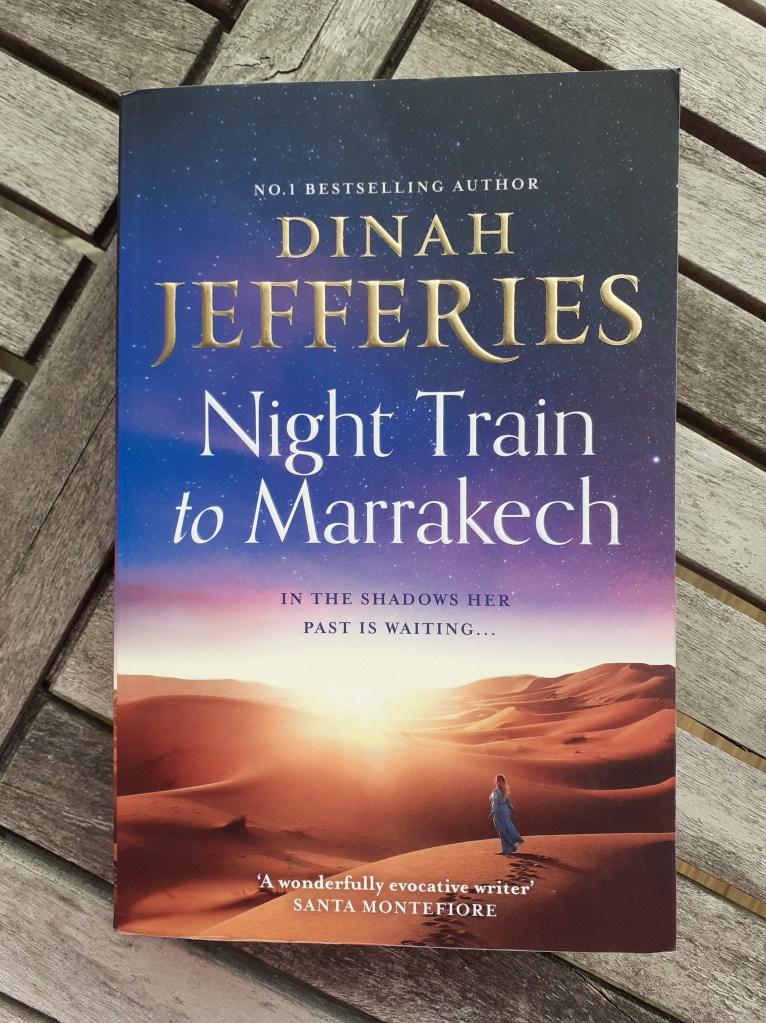
I was also a bit confused about the title and the cover art. Gorgeous as they are, they didn’t connect to the story. The desert plays no part in the story. The summary on the back cover mentions an “epic journey” and yes, travelling to Marrakech in those days involved taking a long train ride from Tangier or Casablanca. But within two paragraphs, Vicky arrives in Marrakech and the whole journey really plays no part in the character development.
All characters that are travelling into Marrakech take this train but it’s only mentioned in passing for them. The station also plays no central role in the story, and it’s just a place to go pick up new characters.
Then I thought the train must be a metaphor but I couldn’t really make that fit either. If the “epic journey” is meant figuratively, I don’t find it fitting either because the main character just isn’t going through enough development to make that stick.
The book’s strong parts were the descriptions, the way that the city is described, the experience of being in the souk for the first time, the intense heat, the colours and the smells. The riad’s, the Atlas Mountains, and the food; it was all spot-on and it took me right back.
I really wanted to love this book, and maybe my expectations were too high, but it just left me disappointed.
If you have this book on your reading wish-list, I strongly suggest reading the other titles of the series first (Daughters of War, and The Hidden Palace) because I don’t think this really works as a stand-alone and it might help understand some of the plot choices better.
 Bookworm in the City