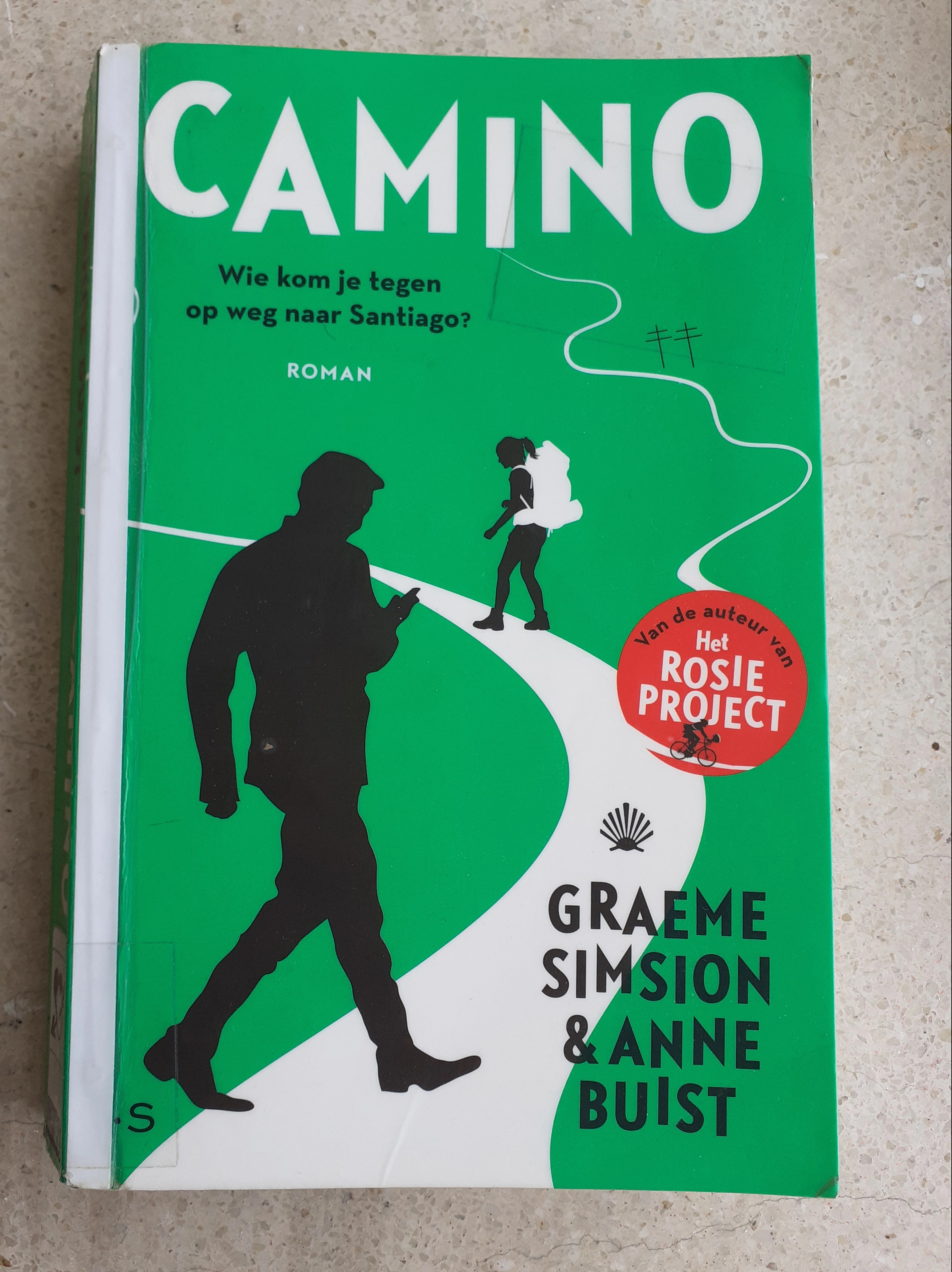
No. 6: A book with a green cover
Camino / Graeme Simsion & Anne Buist
Original title: Two Steps Forward
Once again, I was roaming the library, checking book by book for any that fit my challenge. I quickly learned that a green spine doesn’t necessarily indicate a green cover, and if the cover wasn’t green, the book went back without further checking. As it turns out: green is not exactly the current “it” colour for covers. Teal or blueish-green is used a lot more, but of course I wanted to be as green as possible to avoid any discussion, so when I couldn’t find anything in the English language section of the library I resorted to the Dutch language section, where I finally pulled this one off the shelf.
Originally published as Two Steps Forward, it is written by the author of the Rosie Project books, and his wife. I’ve got to admit I’ve ignored this author on purpose after my great disappointment in the second book of the Rosie series. But with limited options I gave him (them) another chance. I was left with mixed feelings.
The book is about American Zoe and English Martin, who meet-cute in Cluny, France.
Martin fled there to teach technical design after his marriage collapsed, and Zoe is there to visit her old exchange student friend Camille.
Zoe discovers that the town is a stop for the camino and in a spur of the moment decides to go walk the path even though she’s only been in town for half a day. Within an afternoon she arranges the special pass, gets a backpack and fills it with some items from her suitcase. With a return ticket already booked she has limited time (and funding) available to finish, and instead of ending in Santiago de Compostela, makes the French-Spanish border her finish line. If you think she’s a spontaneous kind of person who does things on a whim all the time, you’re wrong: she’s just not in a normal mindset because only three weeks earlier her husband had suddenly died. And that’s not all because after his death she found out that he had accumulated a debt so big, that she would be forced to sell the house. She’s trying to come to terms with it all, even if she doesn’t recognize that yet.
Martin has lived in Cluny for almost a year and despite that, suddenly is hit by the same urgency to start walking. He’s come up with a design for a cart that can be dragged along by a hiker so they won’t have to carry the weight of a backpack. There is a big travel convention planned in two months and he needs to have tested the cart before then so he can sell the design. This is how they both end up receiving instructions and their path passes at the same time.
Even if you don’t know anything about the pilgrim route, the story is easy to follow: there’s a map provided at the first page (two books in a row with maps!) and because Zoe and Martin don’t know anything (or much) about it, you get to discover along with them.
All I knew about the camino before reading this book, was that it ends in Santiago, and the French route is marked with scallops, which in French and Dutch are named after Saint Jacob, the patron saint of the route.
The chapters are switching perspective on and off, but because Zoe and Martin’s voices aren’t distinctly different enough, at times I had to leaf back to check whose chapter I was reading. I consider that a fail for the concept.
The first half of their walk is very descriptive and very much a story of people discovering what it means to walk the old pilgrim path alone: the French countryside, the small towns, and finding places to sleep and eat, are well-described. (You can tell that the authors walked the path, which gives some much-needed extra weight to the story.) But then there’s a turning point and the story becomes more of a dramedy with a will-they-won’t-they arc.
Despite the heavy personal reasons for the main characters to go walking, they remain lightweights. Also, they spent the majority of their walk apart, doing their own thing, occasionally bumping into each other. I didn’t understand their so-called connection, and their lack of communication was annoying. When they are about to get together, Zoe receives news from her daughters and leaves right away. She writes a note that says “I’m sorry” and is gone. No wonder Martin is peeved. Could she really not have waited two minutes for him to finish his shower and talked to him? Or written a bit more to explain? It felt unnecessary and childish, especially because earlier, she’d told Martin that repairing his relationship with his daughter wouldn’t require much more than simply communicating. Practice what you preach, lady.
As a third act there is also the theme of self-discovery that pops up after all. It seemed strange to me that Zoe was communicating more with an editor than with her own daughters or Martin.
It felt like everything was thrown at this story and some things stuck better than others. Sometimes less truly is more, and for me it would have worked better if the authors had stuck to one thing: make it either a good travel story, a good romance, or a good story of personal development. Right now, for me, it was a miss for all three. I also thought the people that Zoe and Martin meet along the way were simply more interesting than them.
When a friend asked me to describe it in max ten words I said: a tame rom-com set on the camino.
Maybe I didn’t feel this book because I know there are other, better, books on the same topics out there. (The Salt Path by Raynor Winn is an absolute standout for me.)
Or maybe I should give up and admit that this author’s writing just isn’t for me and/or I’m not the right reader for his(their) books.

 Bookworm in the City