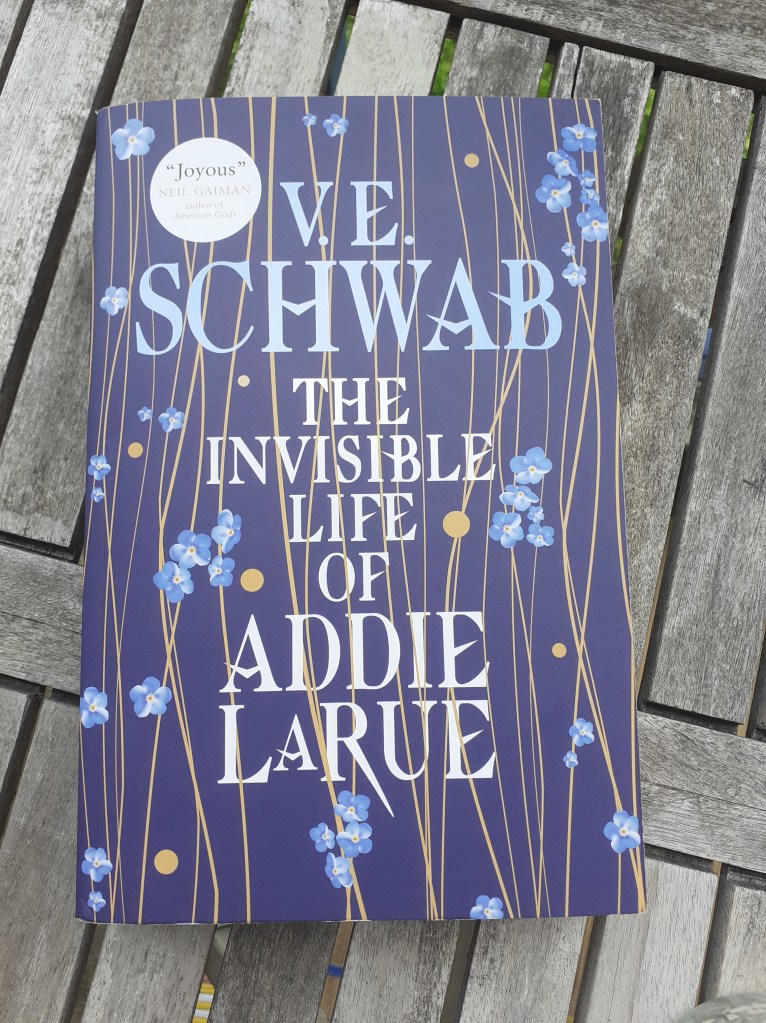
No. 5: A book I started but never finished The Invisible Life of Addie LaRue / V.E. Schwab
I remember I bought this book during one of the lockdowns because I thought I deserved a treat and I was so happy when it arrived (remember when a trip to the mailbox was the highlight of the day?), that I started it right away. I really don’t know why I never got very far in it, other than it being a big book coming in at over 500 pages, and during pandemic times I had the attention span of a confused gold fish. I found the Bookdepository (RIP) bookmarker still stuck between pages 55-56 and I vaguely remembered what I’d read, but the details eluded me, so I started over from the beginning.
This is a book that has everything going for it: gorgeous cover, great lay-out, and nice print. Yes, it’s big, but once I committed properly, I blew through it and this time around finished it within a weekend. The writing is easy, and Addie is a great character. The story starts in 1714 when Adeline LaRue lives in a small village in France. Her parents are relieved that at twenty-three she finally is getting married, but Adeline, who doesn’t even like the man, fears that marriage will leave her virtually chained to the village, and she is desperate to find a last-minute escape. In her desperation she makes a deal with the devil and in return for her soul, he gives her freedom and with that a chance to live the life she’s always wanted for as long as she wants. But you don’t “just” make a deal with the devil and Adeline soon discovers that she should have been more careful with her words because the downside to her deal is, that nobody remembers her. The devil gave her the “ultimate freedom” of not being remembered. She forever has to introduce herself and cannot even use her own name. She also cannot create anything herself; it gets erased right away. It takes Addie some time to get used to this new way of living, but she manages. She leaves the village and goes to Paris where she learns it’s easier to be invisible amongst big crowds. She is visited there by “Luc” on the anniversary of their deal and he offers her an out: say the word and he’ll collect her soul and relieves her of the hard knock life she’s found herself in. But Addie is not done living and refuses the offer. Every year on the anniversary Luc makes an appearance, and it’s something that Addie starts to look forward to, as he might be the devil, but he’s also the only one to remember her and call her by her real name. The two of them bicker and fight, and at times Luc punishes her by not showing up for a year or two. This goes on for three hundred years, and lands us in the present of 2014. By then, Addie has been living in New York for quite some time, a city she enjoys as there is so much to discover. One of the things she discovers, is Henry. Henry works in a bookshop and when she goes back to return a book (after having it stolen a few days before), he recognizes her and chases her out of the shop (again). The shock of someone remembering and recognizing her, has Addie startled more than being caught scamming. Thinking it’s a fluke, she doesn’t dare believe it actually is possible until she goes back to offer him an apology and he still remembers her. After spending three hundred years of reintroducing herself to people over and over again, slinking in and out of people’s lives, and nobody but the devil remembering her name, it is a welcome relief. Although Henry clearly has a secret to hide himself, Addie is too relieved to be bothered by that. Their connection is immediate and intense and although she has to constantly introduce herself whenever they meet up with his friends, they both are fully committed to the relationship. She quickly decides she needs to trust Henry with her secret and he’s strangely easily okay with it all. She starts telling Henry everything, and he writes down her story, thinking this way she can leave her mark after all. But through her story, he discovers she’s already done that, having been a muse to painters, sculptures and musicians throughout the ages. Songs and pieces have been written and created because of her, and she shows up in paintings as “unknown woman”. But the devil is due a visit because it’s been almost fifteen years since his last, and Addie knows they won’t have long. When Luc does show up, he shows up with the oomph you would expect from the devil. Just in time for the big finale.
And this is why I believe in second chances: I really liked this book the second time around! The set-up is well done, and Addie and Luc are great characters. At times I wanted more depth from the historical settings and the people Addie meets, because they remain blurry. Although eventually that works, because it keeps the focus on Addie and Luc. I have to admit I saw the twists at the end coming so the build-up to that felt a bit too slow and stretched out, and whatever story-telling was still happening, could have been left out for me. But this is a storybook-like telling, a great (love-hate) story, and totally enchanting. If any of that is your thing, don’t hesitate picking up this book!
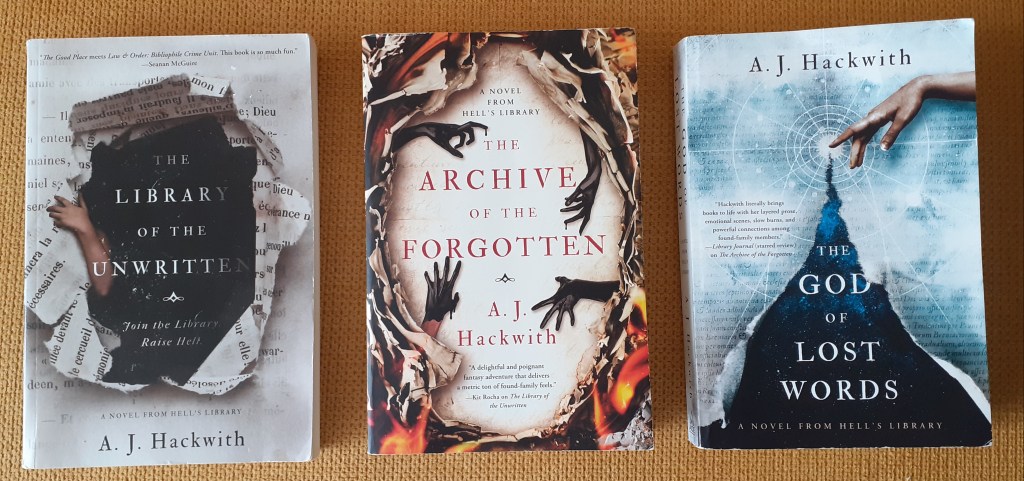
No. 22: A trilogy Hell’s Library series / A.J. Hackwith
I don’t read a lot of trilogies. In all honesty I have a hard time thinking of another set of three books I read. So, yay for the reading challenge expending my reading experience! The trilogy I ended up with was by total accident: I got the first book purely based on the title and cover art and only found out it was the first of three books when I looked up more information online. So, I happily made sure to get my hands on parts two and three as well, and here we are.
The Library of the Unwritten / A.J. Hackwith
Book 1: The Library of the Unwritten (2019) Fantasy is not a genre I would pick under normal circumstances, because the world-building can be, dare I say it, tedious with too much detail. It’s a fine line between too much and not enough, and I guess the closer to the “known” the world setting is, the easier it is for the reader to be left to figure stuff out. For me that was the case with this book, as it is worldly unworldly. The Library of the Unwritten, is part of Hell’s library, and is exactly what it sounds like: a library full of books that were started, but never finished. There are muses with pieces of text tattooed on their bodies, who live with damsels that fell out of their books and for whatever reason, couldn’t get back in. The library users are demons and the like, allowed to use the materials inside the library but not take any of it out. There is a librarian in charge, doomed to keep the characters where they should be. Then one day Hero falls out of a book. Hero is classically handsome, and has one goal: to rescue his heroine, his author. He manages to escape the library and travel to earth, and when librarian Claire discovers this, she has to chase him through time and place to get him back into his book. That’s easier said than done, because she knows that when she leaves the library unguarded, well, all hell is about to break loose. And leaving the library is complicated enough, but getting back even more so, because the devil sends guards after them, and that’s not to get them back, but to eliminate them. Nobody is allowed to leave the library. Claire doesn’t have to chase Hero on her own, because Brevity travels with her. Brevity is a muse, and library assistant. She has green hair and purple skin with text tattooed on it. On their way they face challenges, engage in literature duels (awesome: participants hit each other with quotes), and need to track down a potion. They get stuck in a maze and have their souls weighted. And because the people they meet along the way all seem to have a hidden agenda, figuring out who’s friend or foe is difficult. All along they know that the situation in the Library is getting bad, and the urgency of finding their way back grows with every moment spent outside it. I loved the settings (the gargoyle guarding the library, inter world loan system), and the characters were interesting enough to want to read more.
If you want to read this series, you might not want to continue this entry because what follows contains spoilers that might ruin your appetite and I’d hate to be responsible.
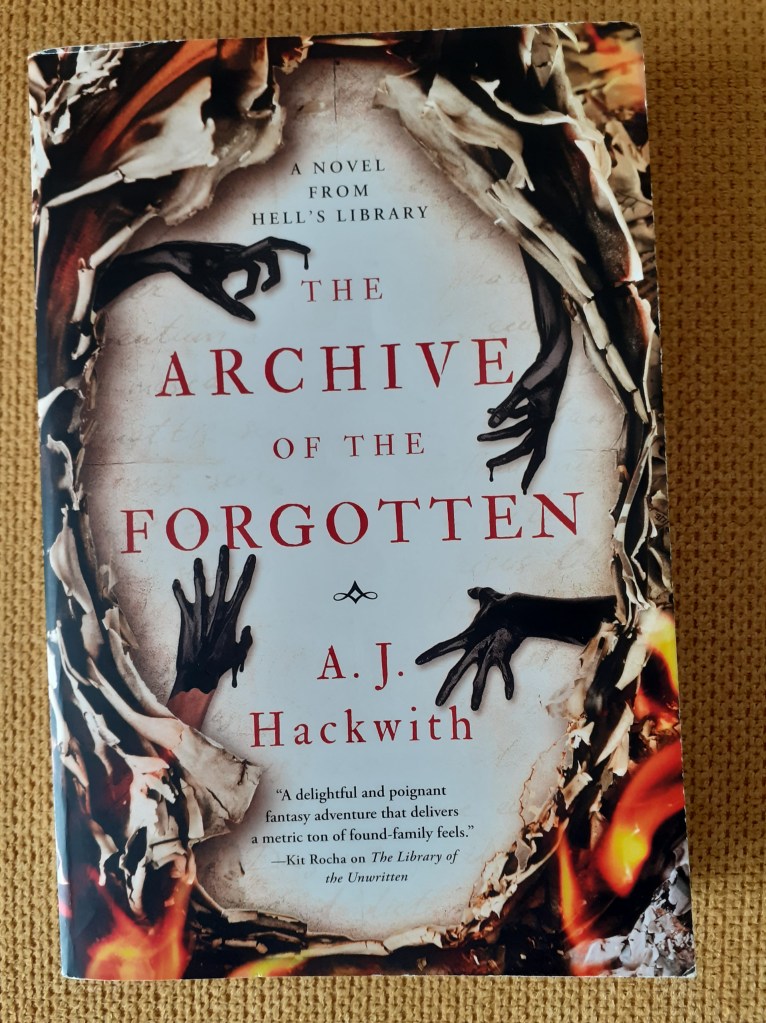
The Archive of the Forgotten / A.J. Hackwith
Book 2: The Archive of the Forgotten (2020) This book opens where the first ended: the heroes have returned to the Library of the Unwritten and the dust of the big end fight is still settling. Claire is no longer the librarian, but has moved on to be the Arcanist, the keeper of the keeps of the Archive of the Forgotten. Fallen angel Rami has become her assistant. Muse Brevity is now the librarian of the Library of the Unwritten, with Hero as her assistant librarian. When a mysterious inkwell appears on the library floor, they all go to check it out, and after reaching in, Claire’s hand turns completely ink black. The gang needs to figure out how to help her, what effects the ink have on a human, and how to avoid the ink to spread. This sets off a chase across the realms once more for Hero and Rami. Claire stays at the Archives to establish what kind of ink it is. For this, she needs help from the damsels that live in the library but the relationship between Claire and Brevity is strained, making things move along slowly. It doesn’t help that Claire is distrusting of Brevity’s muse friend Probity. Although everybody takes a different path, they all end up at the same place: the Dust Wing. This graveyard of books is where the finale takes place and we learn that it’s not about books, stories or writers, but souls. And that muses want to be their own person, and not just be connected to an artist. We also learn that heroes should ask for permission to kiss someone because otherwise they’re no better than villains after all. (Applause for that line.)
The story was easy to pick up because I knew the characters and was familiar with the setting. After the initial action of Claire getting stained by the ink, things slowed down a bit too much for my liking. There was a lot of interpersonal drama, which makes sense because the characters were left unsettled and have to get used to their new positions and roles, but that part wasn’t my favorite. Things picked up once Rami and Hero started to travel to other realms again, but by then the book was half-way through. Also, they returned fairly soon and it meant the story slowed down again. For me, this was the weakest book in the series. I don’t read nearly enough trilogies to know if hat is a common thing to happen with the middle book.
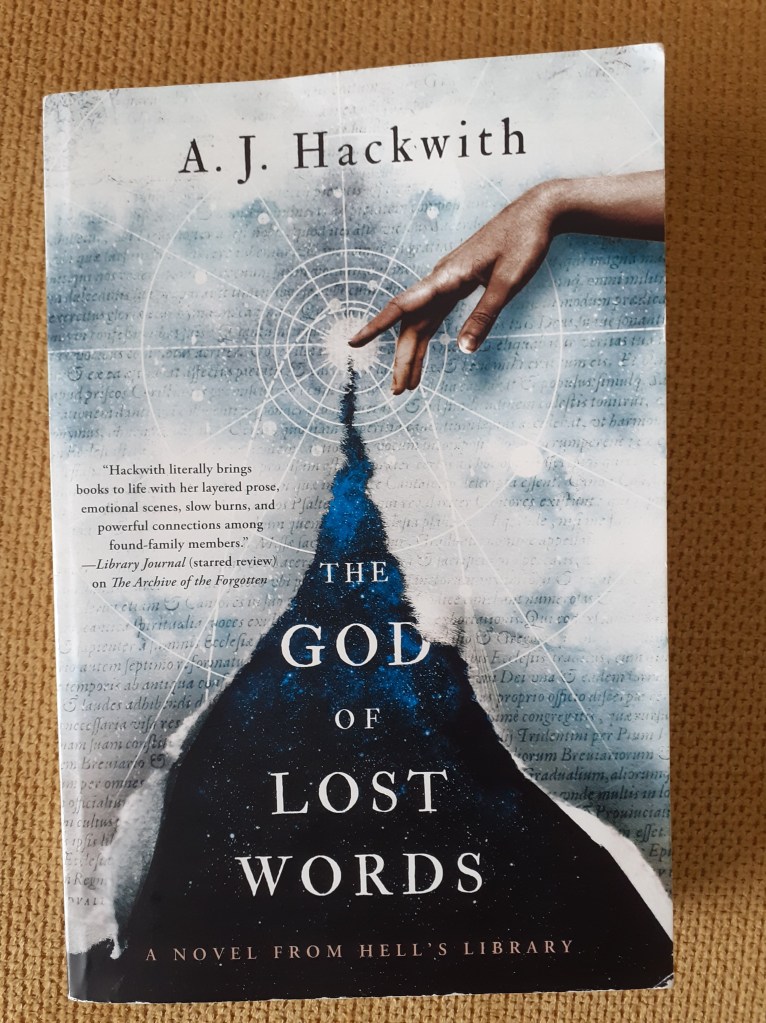
The God of Lost Words / A.J. Hackwith
Book 3: The God of Lost Words (2021) And again, the book starts right where the previous one left off. Hero feels lost without his book, Claire is still upset about her stain, and Brevity is recovering from the betrayal of her sister muse. Then, a new well appears in the library and everybody is on high alert this time. The well doesn’t contain ink though, but clear water, and through it travels Echo, the librarian of the Elysium Library. Rami and Hero had visited there in the previous book and with their presence they had awakened the books in the Elysium Library. Talking stories in an echo place is not a safe space, so the librarian is now seeking a place to hide. They’ve come to the Library of the Unwritten and without so much as a pretty please, bring in their materials. Another person to visit, is Malphas. This dangerous figure is one of Hell’s generals and sets fire to the Arcane Wing, leaving Claire and Rami to seek refuge in the Library as well. The place is quickly becoming overcrowded, and not necessarily the safe space they all need. Realizing they are sitting ducks and that the best defense is an offence, the crew decides on a plan of attack. With an all-for-one-one-for-all ‘tude they get to working on creating a realm of their own. Which means that they need a space, a god, and a guard. To establish this, they need help from the libraries in the other realms and they set about to get the librarians on board. It’s a reunion with some of the characters from the first book and some new ones. Like in the first book, there is a sense of urgency with this story that keeps the momentum going. During their inter-world librarian meeting Malphas makes her attack and floods the Library of the Unwritten. Everybody is stuck but a plan starts to form and our band of characters jump into action: Rami and Claire lead the negotiations with hell’s general, Brevity uses her muse skills to keep what is left of the library safe, and Hero dives back into the Dust Wing. The ending was nicely done with the Library telling the finale. It read like a movie.
I didn’t know I needed a trilogy set in hell’s library, but sometimes the books just find you and it’s a great find and all in all I’m really happy having read this trilogy. The library setting is super cool and made me smile plenty. The main characters are pretty kick-ass, and the bittersweet ending was unexpected and gave it all just a little bit extra.
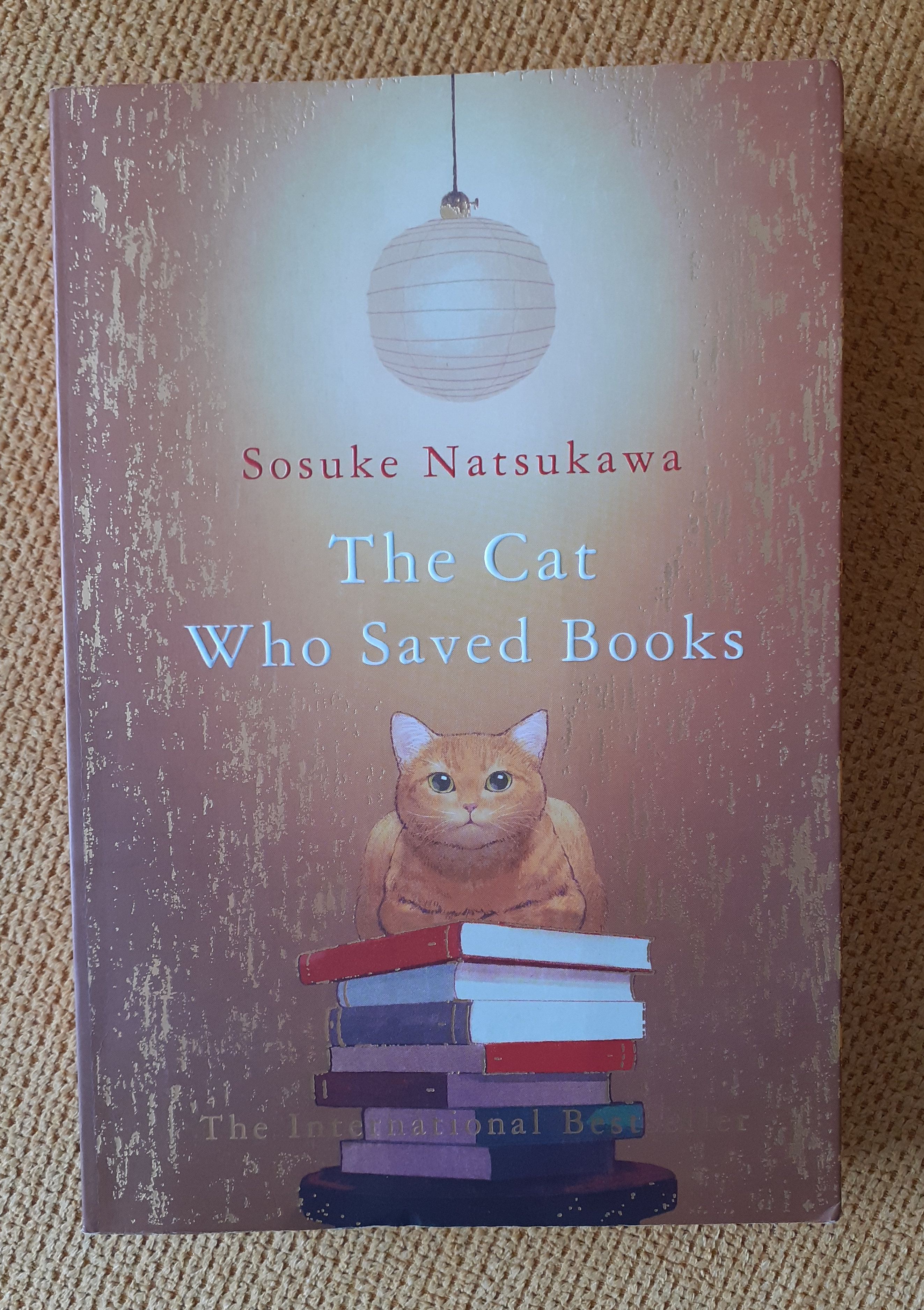
If I could use only one word to describe this book, I would use: adorable. Thankfully, there is no word count limitation in the world of this bookworm, so here’s everything else I have to say about it.
Rintaro Natsuki is a teenager when his grandfather dies. Suddenly, it’s just him and the Natsuki Books bookshop. This second-hand bookshop sounds amazing; completely unassuming but with a unique collection of collector’s items and a proprietor who knows a lot about books. Without parents and now without his grandfather as well, Rintaro rightfully feels lost and scared. He quits going to school, and stays back to run the shop until his aunt has made the necessary arrangements to sell the business and take him in. Two of his classmates visit him: the popular and smart Akiba, and class representative and music geek Sayo. They both try to convince him to come back to school, and assure him he’s being missed by his classmates. Rintaro isn’t so sure about that and prefers to stay at the bookshop. So, they make it a mission to regularly check in on him. Someone else to enter the shop, is Tiger the tabby. This cat isn’t just any tabby, it can talk. And it’s telling Rintaro that he needs to go on a mission. A mission to save books from people who mistreat them. Rintaro doesn’t know what else to do, and simply follows the cat through a doorway that hadn’t existed before, only to find himself emerge on the other side inside the big home of a book collector. The man claims to care so much for books that he locks them in cabinets, behind bars. Rintaro has to discover why this is wrong, what the threat is, and how to resolve it. Sayo happens to be in the shop when Tiger the tabby appears for the second mission. She won’t hear “no” and joins Rintaro and Tiger on the mission.
There is a total of four labyrinths for Rintaro to finish. In between challenges he is back at the shop, faced with the painful reality of life. Although hesitant and scared during the first mission, he’s happy to dive in by the time mission number three is announced.
The only thing in this book I had a bit of trouble with, was the timeline. At one point it’s made clear that everybody is concerned about Rintaro still grieving and not feeling up to joining daily life, because it had been two whole days since his grandfather’s memorial which seemed extreme to me. I’m jotting this down to cultural differences.
This book is a very nicely written modern fairy tale. True to fairy-tale style the moral of the story is loud and unmistakable, but it’s so nicely done that I’m willing to accept that. If you like to read fairy-tales, fantasy, anything to do with books, reading, or cats, you’ll like this book.
No. 12: A book written by an author with the same initials as me The Wives / Lauren Weisberger
LW. That’s me. And Lauren Weisberger. I remember the joy that was The Devil Wears Prada (first the book, then the movie) and I have to admit that when I realized The Wives continues with the story of Runway assistant Emily, I had my doubts. But, I was also curious enough to give it a go and I’m happy to report that I have no regrets!
This book takes place years later, and Emily no longer works for Miranda Priestly but is still tough-as-nails, and uses her skills as an independent image consultant. Unfortunately, more and more of her clients get poached by a newcomer who is all about the latest social media platforms, while Emily still uses Facebook. After a mission leaves her stranded in New York, she decides to stop by her old friend Miriam. Miriam has recently moved to the suburbs of Connecticut and given up her job at a big city law firm to be a full-time mom. Emily is appalled by life in the suburbs but without any new clients lined up, and her husband on a long work trip to Asia, she decides to stay with Miriam and her family for a few weeks nonetheless. It’s during this time that Miriam is contacted by her other old friend Karolina, former super model and wife of a senator. Karolina has been arrested for drink-driving with children in the car, and her husband is throwing her in front of the bus (press). She’s fled to their second home in Connecticut and when Miriam goes to visit her, she brings Emily along. Emily actually knows Karolina back from her super model days, when she would regularly be at the Runway office. The three of them quickly renew their friendship and it is Emily who tells Karolina to grow a pair and hit back at her husband. With a lawyer and an image consultant in her corner, Karolina isn’t as helpless as her husband seems to think and they manage to hit him where it hurts the most.
In between the revenge-getting the women each have their own lives and are battling their own insecurities. But they strengthen and support each other along the way, and learn what it means to stay true to yourself, which even in suburbia isn’t easy. Miriam and Karolina would have been boring characters without Emily’s gutsy presence to shake things up, and Emily needs a bit of sanity around her which these two provide. Of course, Miranda Priestly makes a guest appearance and is still the bitchy boss we all love (to hate). (Andy also pops up, although she has a cameo at best.)
All in all this book was a relaxed read and surprisingly fun sequel.
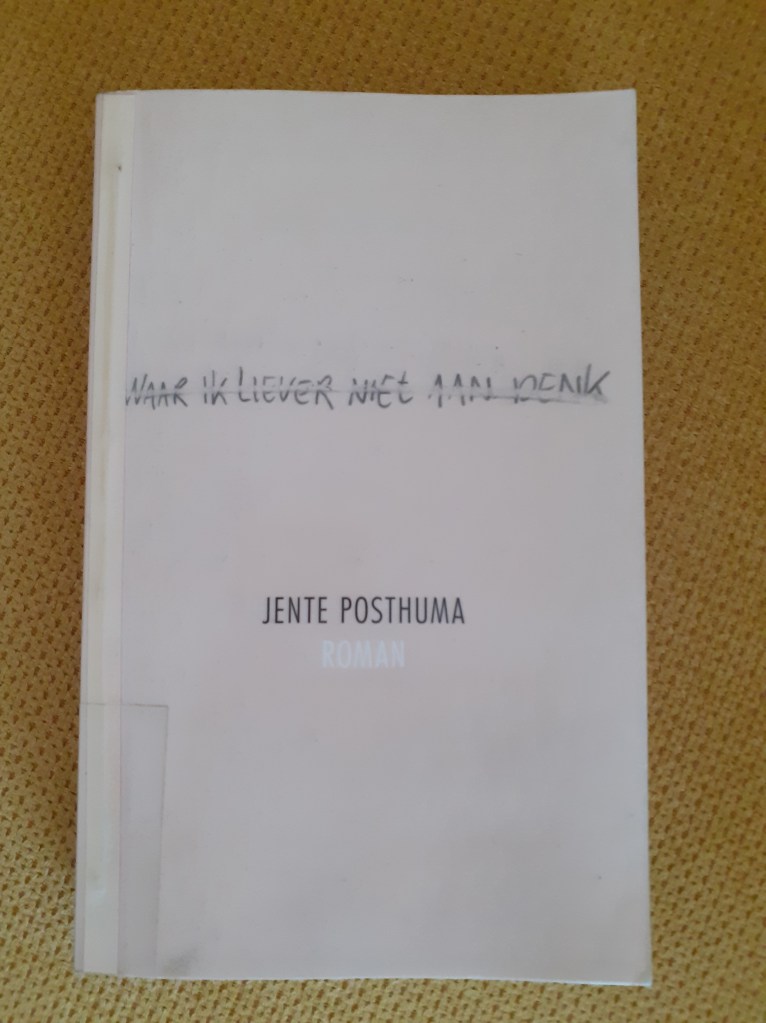
No. 9: A book set in my country Waar ik liever niet aan denk / Jente Posthuma (translated as: What I’d rather not think about)
This book was published back in 2020 but I only learned about it when it was shortlisted for the Booker International 2024. Go figure. I wasn’t the only one because I immediately went to make a reservation in the library and received a notification saying I was number five in line. It was so worth the wait.
This book is the story of a brother and sister. They call themselves One (brother) and Two (sister), after their birth order. They are twins, and have always been close. But the brother doesn’t want to live and takes his own life, and the sister can’t figure out life without him.
Two tells the story and it’s a story of twins growing up in a village, before moving to the big city. Like no names are given, no locations are either. It’s all neutral but still easy to picture. Two has a dry and dark way to describe her upbringing, for example not recognizing their father walking out on the family, and dying shortly after, as a traumatic event because it wasn’t as serious as surviving a concentration camp would have been. (She’s slightly obsessed with concentration camps and Joseph Mengele (who in turn was obsessed with twins).) As adults, One and Two start to carve out their own paths although they end up living on opposite ends of the same park remaining physically close. It is One who starts to take more distance though, needing space: he refuses to travel to New York, even though they have planned to visit their aunt who lives there, and prefers to spend time with a chosen family of fellow gay people over his blood relative. One fails his interview for graphic design studies, can’t figure out what it means to be happy, and has difficulty maintaining meaningful relationships. Two’s at times awkward responses, don’t help. These are two people who are similar and grew up close, but still don’t understand each other as adults. It’s when One’s depression grows deeper that they become closer again and Two spends more nights with her brother than her husband, not wanting him to be alone. But when someone wants to die, they find a moment and a way. One’s death leaves Two completely at a loss. Although aware of the strain it’s putting on her marriage she still ignores her husband and spends even more time at One’s apartment than at her own, reading his diaries over and over, trying to figure out what drove him and what she could have done differently. Not knowing how to move on, she slowly comes to a standstill.
The setting of the book doesn’t involve windmills, tulip fields, or gabled houses lining pretty canals. It even takes a while for it to be explicitly clear that this is set in the NL. It’s subtle with the occasional bike ride, or swim in the canal. It’s very Dutch in its directness and straightforwardness though, and, completely fitting the story, the most Dutch thing in it is the way One ends his life.
This book is just like its cover: void of unnecessary adornments. The stripped back style makes it easy to read despite the heavy subject, and the unexpected funny parts offered both relief and sadness. I felt that the style complimented the subject and it completely sucked me in. Grief, depression and suicide are not subjects for everyone, but this was so beautifully done that I still am recommending the book to anyone who is open to it.
Waar ik liever niet aan denk / Jente Posthuma (translated as: What I’d rather not think about)
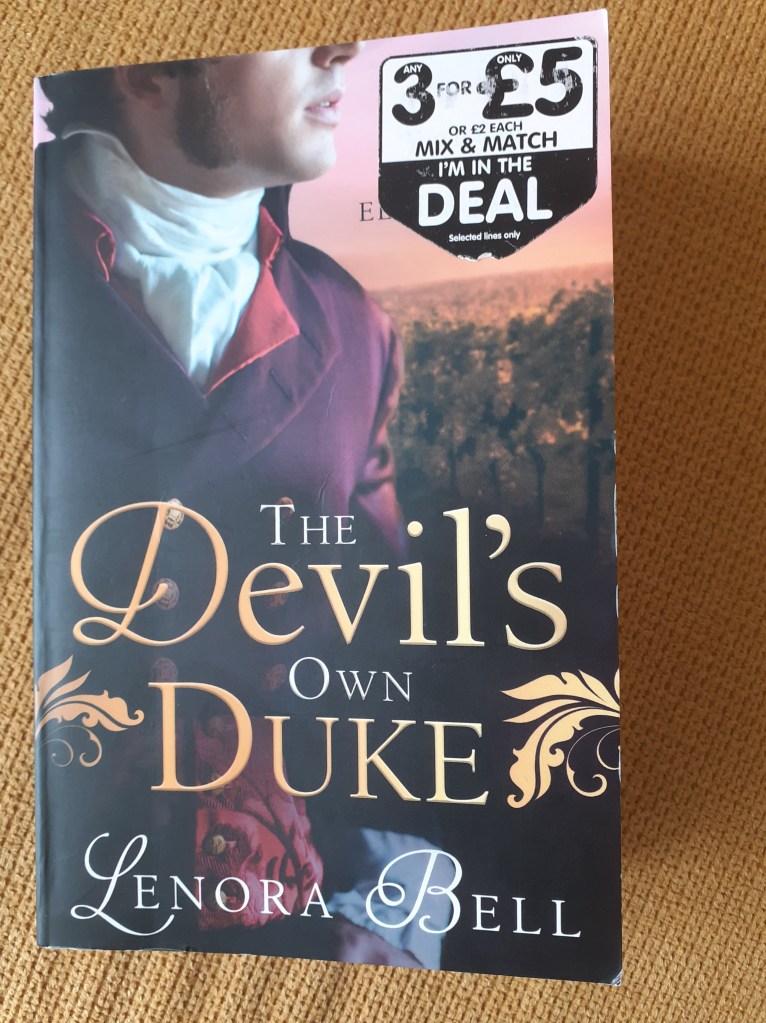
This was the second book taken from the hotel library (exchanged, actually; I left books in return of course!). It’s easily as ridiculous as the Betty Neels book, coincidentally also has a heroine named Henrietta, whose age of four and twenty is more appropriate for the time, but that’s where all comparisons end. This one has enjoyable characters to take you through the story. Also, this story is not chaste at all so if that’s not your thing, steer clear.
The story goes as follows. Henrietta is the only child of the Duke of Granville, which in the mid-ish 1800s (no specific year is given) is a problem, because as a woman she’s not allowed to inherit the dukedom. Henrietta is smart, sharp and an entrepreneur, so she sets out to marry her widower father off so he can sire an heir. Her father though, isn’t into this one bit. Henrietta won’t listen to his objections and plows ahead, organizing a ball with any young woman of peerage in attendance. She’s all too aware that without an heir the dukedom will fall to the Crown after her father’s death and that means she will lose the family vineyard business. At this ball she meets Ash Ellis, who of course is tall, broad-shouldered and handsome as sin. She doesn’t know who he is, but can’t refuse a waltz with this rogue without causing a scene. So they dance and it’s lust at first sight for both of them. Henrietta, happily settled into spinsterhood because who needs a man to distract them from running a business, doesn’t know what to do with these sudden feelings. She decides a woman deserves at least one kiss in her life and Ash all too happily agrees. They are spotted by her father though, so a marriage is happening, no matter how much she objects. Her father won’t hear no, especially not when it is revealed that Ash is actually a long lost relative, and the only one eligible to inherit the dukedom and save it from going to the Crown. The duke is so happy that he doesn’t have to marry any of the women at the ball, and can now elope with his mistress instead, that Henrietta’s objections are overruled on all fronts. The tables have turned on Henrietta which isn’t easy for her to admit. Because she fears that marriage will be the death of her vineyards as much as losing them to the Crown, she goes to the Boadicea Club for Ladies that she is a member of, and seeks the wisdom and input of her friends. (Who all sound pretty awesome, by the way.) After the necessary complaining about men holding all the power, they create a list of pros and cons for marriage to Ash. It ends up being even, and defeated Henrietta decides to get the most out of it and makes Ash sign a document of guidelines and rules for their marriage. It’s not a spoiler to reveal that Ash of course, is running a con on the family, eager to work himself up from the lowest of the low, to the highest possible. He’s not just a bare-knuckle boxing game den owner though, he has his sights set on making a change in child labour laws and he can only do that as a member of the peerage. He was a child labourer himself, before falling into a life of pickpocketing and conning. Henrietta and Ash don’t trust each other and play their cards close to the chest. They are forced into a marriage neither wants. The only things they have in common is that they both want to be in charge, and that they have a lot of pants feelings for each other.
As said: this story is as ridiculous as the others. The ridiculousness comes from the story being so over the top though, not from a lack of story or character. It was published way more recently in 2021, so that makes it more current, even though it takes place in the 1800s, as it clearly is written with a modern view. But what makes this the clear winner, is that the characters have character and as a reader you get to know them and what drives them. Henrietta is not just smart, but feisty and stubborn as well. When she finds out Ash is secretly smitten with his cat, gentle with children, and protective of the people he cares about, she has to admit that he is not the dangerous devil that he makes the world believe he is. Ash learns that even though Henrietta grew up in the safe bubble of nobility, she’s not blind to the problems of the real world and willing to adjust, and fighting for change in her own way. They both have to admit they were wrong and make changes in their approaches. They are both passionate for what they believe in, and because those standpoints are opposing they bicker a lot. Their bickering is a lot of fun because neither is used to losing arguments, and it means that sparks are flying. And because this is a romance novel, we all know it ends with a happily ever after.
All in all this book is an easy escape read for anyone who likes the Bridgerton books (or series).
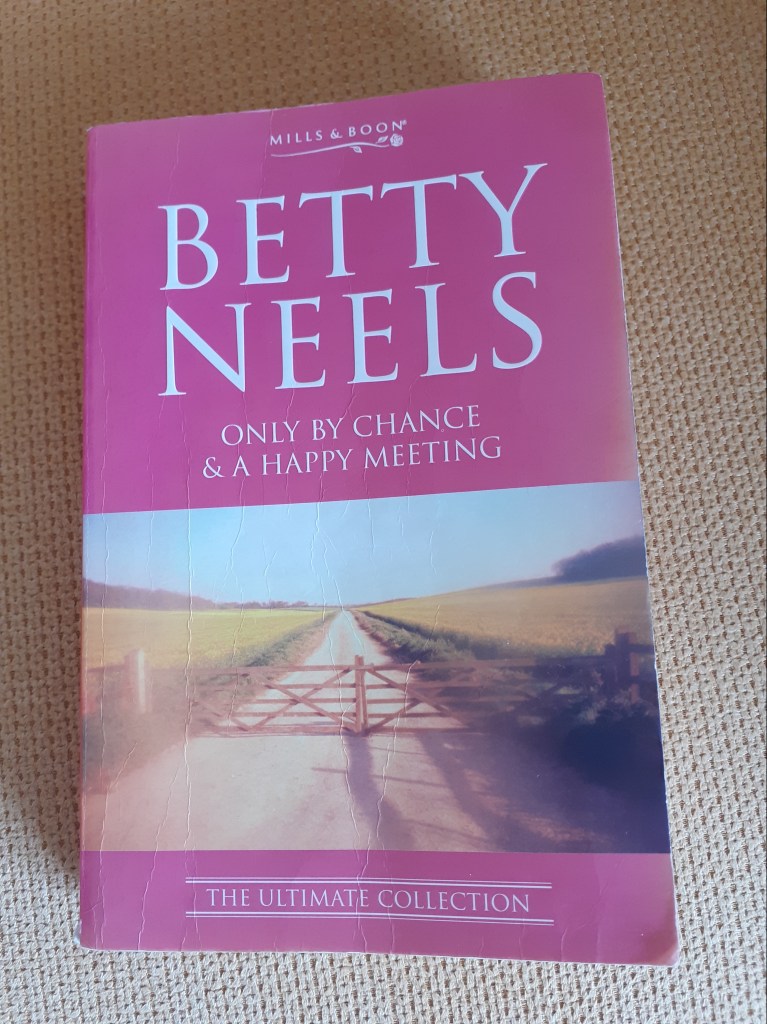
Only By Chance & A Happy Meeting (The Ultimate Collection, volume 3) / Betty Neels
Oh boy. Put your seat in an upright position and brace yourself, because this book is a lot and I have a lot to say about it. I picked this book from the hotel library during a recent holiday. The reason I picked it, was because it was one of few in English, it was clearly well-read, and it seemed ridiculous. I was in the mood for ridiculous, and did this book deliver! The book contains two stories, which were originally published in 1996 and 1992 respectively, but collectively re-published in 2002 as part of the Ultimate Collection, after the author’s passing. From the introduction I learned that the author was writing until in her nineties and apparently, she had a large following of fans. I’m glad for this lady, and the success she had and I don’t mean to offend her or any of the many fans, but, oof, is this some painfully old-skool stuff! These two particular stories are Cinderella themed romance novels that manage to not be romantic at all. I feel like the author got stuck in an earlier period of time, as the stories felt so old and dated. At one point I even went back to the title page to check the year of publication because I thought I must have misread. Not only did I pick a book for myself, but gifted one (review available here sometime soon) to travel companion friend P. We spent two evenings reading out lines of ridiculousness to each other, and even attempted to create a mix-and-match story by knitting the two stories together. Although that didn’t work, it was funny enough to have us in – wait for it – stitches.
The first book in this bundle is called Only By Chance (1996). The heroine in this is Henrietta, an orphan goodie-two-shoes who is “definitely not pretty”, poor, and basically living in squalor in London’s East End. She has to work three jobs to make a living: part-time at the hospital, as an office cleaner on weekdays in the early mornings, and on Saturdays at a market stall. She has two rescue cats, because of course. It’s so Dickensian. Then she gets sick and is brought to the clinic for poor people by her landlady and the greengrocer. Adam Ross-Pitt is the doctor on call and recognizes her from the hospital where he also works. He’s a neurosurgeon but also works at the clinic (that he helped co-found), to help the less fortunate, donating large sums of money anonymously, and devoting his time. Obviously, he’s the Hero. He diagnoses Henrietta with the flu, and because he knows her and learns she has no family to take care of her, he brings her home. As he climbs the stairs while carrying her all the way up to the attic, his “magnificent nose” picks up the scent of boiled cabbage. (This had me laughing out loud, and the term “magnificent nose” became a running gag during the remainder of the holiday because how could it not?) Later on, the doctor puts his “great brain” to work, and it’s mentioned that he’s got “big feet”. All descriptions of the man are positive, or in a way to describe him as a wonderful specimen. Descriptions of Henrietta though, are solely negative. She’s “plain” and “not pretty” (this is mentioned several times), she has “mousy hair” and wears “drab outfits”. Her innocence is considered “naïve”. In any case, the doctor pays the landlady to take care of Henrietta, and buys her groceries when he finds out that the kitchen cabinets are near-empty. I feel let down by every doctor I’ve ever had to see. Fearful that she’ll lose her jobs, Henrietta goes out to clean two days later even though she’d not recovered yet, and when the doctor witnesses her nearly collapsing on the road, he picks her up and takes her to the hospital. As a result of her hospital stay, she actually does lose all her jobs, and gets evicted. I thought this was a bit much given that she only stayed at the hospital for a few days, not a few months, and this wasn’t set in the 1890s but 1990s. Still, the doctor feels guilty about all of this and when he’s attending a party in his hometown in the countryside, the lord and lady of the local manor mention that they are looking for new help. So, he tells them he knows someone, drives to London to pick up Henrietta and her few belongings, and drops her and her cats at the house where she becomes one of the many members of staff. The staff at the manor, the people of the village, everybody knows that Mister Ross-Pitt is a catch: after all, he’s a doctor with a magnificent nose and large feet. (I kept reading these descriptions as euphemisms but have a feeling they weren’t meant as such because it was all a tad too serious for that.) Of course, such a catch is being chased: there’s a woman who is set on marrying him and she’s described as wearing glamorous outfits and being mean to people “below her standing”. This Deirdre is the evil stepsister to Henrietta’s Cinderella: she’s the opposite of plain and patient, saintly, Henrietta. Until it turns out that Henrietta isn’t such a saint after all: she expresses to hate Deirdre after their first meeting, which I thought was a bit of a strong emotion, only because she’s in love with Mister Ross-Pitt herself. It’s called jealousy, Henrietta, and it’s not a good look on you. Also, she keeps referring to him as Mister Ross-Pitt. In fact, the story and everybody in it, refers to him as Mister Ross-Pitt up to the point where I actually forgot his first name. This again struck me as such an old-fashioned thing, although, I was willing to accept that the story takes place in British upper class and it involved different social standings. What else to say about Henrietta. She’s supposed to be in her twenties yet wears a scarf to cover her hair like older women do/did. When she goes shopping, she buys pleated skirts and cardigans, and a beige coat that is “nothing special”. She’s twenty-something going on sixty. Everybody loves Henrietta, because she’s such a hardworking, sad, and modest girl. They all think the doctor should choose Henrietta over Deirdre but the doctor is blissfully unawares and only considers Henrietta a friend at most. Then all of a sudden realization hits (I can’t remember why) and he knows he loves her but can’t properly communicate that and instead treats her awkwardly bad, is rude and curt with her. Eyeroll. Then he does start referring to Henrietta in thought as “his Henrietta” and there is a weird moment where he walks up to her and out of nowhere kisses her. Because Henrietta thinks he’s about to marry Deirdre, and Adam thinks Henrietta is in love with another man, it only makes things more uncomfortable between them. His great brain definitely wasn’t working, or he would have known to have, you know, a conversation with her. Instead he goes to America to operate on someone important (of course), returns, and asks her to marry him. And yes, it ended as abruptly and oddly as that. I guess distance made the heart grow fonder? I earmarked pages where truly stupid stuff happens/is said, but there were so many that some pages had to be double-folded because stupid stuff happened on both sides of the page.
It took some time and a lot of liquid courage to get myself started on the second book. A Happy Meeting. This book has an average of 4.15 star rating on Goodreads. And yes, I was sober when I looked that up. 4.15. So many raving 5-star reviews, from reviewers as recent as last year. I’m dumbfounded. This book is a carbon copy of Only By Chance. Or rather the other way around, as A Happy Meeting was published first, in 1992. Sad, mousy, and poor heroine. Doctor hero who saves her. Bunch of fancy big homes with lots of staff. Hero is rumored to marry a society girl nobody likes. Hero and heroine have almost no interaction. There are two kisses before the story ends with an abrupt declaration of love and marriage proposal. This was more like finding the ten differences between the two pictures. The only differences I could find, were in names and locations.
This story starts with heroine Cressida at the side of the road, desperate to flag down a car because she’s twisted her ankle while saving a dog that had been left tied to a tree. (Typical.) Doctor Aldrik van der Linus saves both her and the dog, takes her home (check the box for carrying her up to her room) and leaves her with instructions to stay off her feet for a few days. Of course, Cressida can’t do that because her mean stepmother is treating her horribly and expects her to prep the house for a dinner party. The pain is too much for Cressida, who faints. (Box checked for martyr heroine.) When the doctor finds out about this, he asks his colleague to have a look at her. That doctor sends her straight to the hospital for x-rays but even though nothing is broken, she is made to stay for a few days, which seemed very over the top to me. (What was happening in English hospitals in the 90s that people got to stay a few days for minor injuries?) Cressida is “four and twenty” (honestly) and from the way the doctor is described I thought he was well into his forties, but near the end it’s expressed that he’s only thirty-five. Note, it’s not five and thirty for him. Also, Cressida checks herself out in a looking glass instead of a mirror. I think she considers herself a maiden from ye olden times? Also, again, the descriptions of these two are awful: he’s good-looking, has a great mind, and a “vast back”. (His nose wasn’t magnificent enough to warrant a description though.) She’s “a dab of a girl”, who wishes that she has “even a modicum of good looks”, and has mousy hair. The doctor describes her as unremarkable, with only nice eyes and a pleasant voice. Would it be too much to label this self-plagiarism? It’s basically copy-paste. This also is again a doctor who feels incredibly responsible for someone he’s not responsible for, and goes out of his way to secure Cressida a job. Well, he asks his grandmother to fib about needing a companion. Cressida doesn’t question any of this, is happy to accept and only sad because the doctor is traveling back to The Netherlands where he lives if he’s not visiting his grandmother, saving lives or lecturing wherever else in the world. This book also has so much confusing travel in it. The doctor wants Cressida to be close enough so he can keep an eye on her (creepy), and he sets up another job for her in the NL. He divides his time between a house in Leiden and in a mansion in the middle-of-nowhere Friesland. He goes back and forth all the time, throwing in visits to other places, friends and family as well. He does this in England too. How he has time left to see patients and teach (all over the world!), and have articles published in The Lancet, I don’t know. The first job in the NL is actually arranged by the doctor’s evil girlfriend who sets Cressida up for failure. After that, the doctor arranges another job in Friesland with friends of friends of friends. I think. It got very confusing with all the names and places and all the back-and-forthing. The story is set in autumn and winter, and there’s a big to do about the doctor getting married in the new year. This is only gossip sent into the world by the girlfriend, and nobody bothers to ask the doctor about it. The doctor by then has realized that he cannot continue seeing this woman, but doesn’t do anything to silence the rumors, which causes unnecessary drama. Also, the doctor has spent Christmas with his grandmother in England, and Cressida is super peeved that he hadn’t bothered to send her a Christmas card. He got her medical care and jobs, and now she also wants a card? There’s a lot of weird action in the last twenty pages or so, with a strange accident in Friesland that sees both Cressida and the doctor come to the rescue of two friends. After that, Cressida has to suddenly leave for England to save her old housekeeper from possible eviction. She finds out that the house was already sold, and finds out that the doctor is the buyer. Because of course, he’ll help them out and just randomly buys this woman’s house because she’s important to Cressida and what’s important to her is important to him. He professes his love in the solicitor’s office, which makes her smile, and her smile turns her “ordinary face suddenly beautiful”. And that’s the end.
I don’t understand how any of this story is conceived as wonderfully romantic. It being super chaste is one thing, but the characters again are very much leading their own lives and don’t overlap enough for their so-called connection to be understandable. There’s no equality, no sparkling dialogue, no tension or love at first sight to make this believable. Aldrik is rescuing Cressida from a difficult home situation and claims he wants her to be independent, with a job, income, and home of her own. How rustling up made-up jobs for her is doing any of that, is beyond me. She’s still dependent, but just on different people (the doctor and his friends instead of her evil stepmother). They might be meaning well, but it’s not doing anything to improve her situation at all. Cressida is also not exactly questioning any of these weird twists and turns, and lets herself be picked up and dumped anywhere. She’s not showing any growth, input, or character. She’s as bland as her appearance. Again, I couldn’t believe this was published in the nineties. It was so old-fashioned and just doesn’t hold up for me. Although I wonder if it held up even back then. Of course, it being Cinderella themed doesn’t help either because that story itself suffers from a very passive heroine and cardboard hero (can’t even remember his name?). I need to dive into the Mills and Boons genre more for some much-needed comparison and perspective because this publication managed to get me intrigued. For all the wrong reasons, but intrigued nonetheless. Suggestions for titles are welcome. To be continued for sure. For now though, I’m just so, so, done.
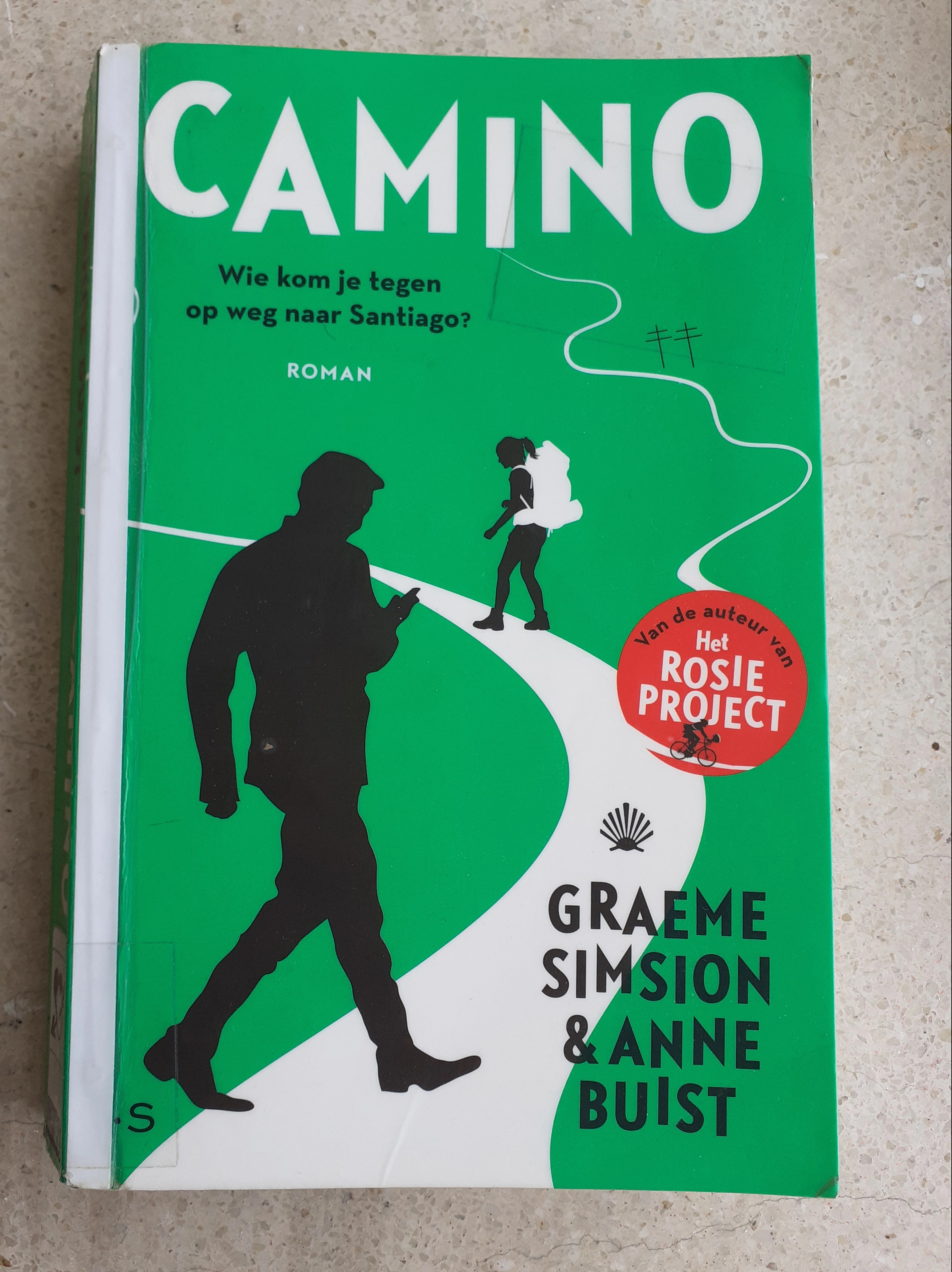
No. 6: A book with a green cover Camino / Graeme Simsion & Anne Buist Original title: Two Steps Forward
Once again, I was roaming the library, checking book by book for any that fit my challenge. I quickly learned that a green spine doesn’t necessarily indicate a green cover, and if the cover wasn’t green, the book went back without further checking. As it turns out: green is not exactly the current “it” colour for covers. Teal or blueish-green is used a lot more, but of course I wanted to be as green as possible to avoid any discussion, so when I couldn’t find anything in the English language section of the library I resorted to the Dutch language section, where I finally pulled this one off the shelf. Originally published as Two Steps Forward, it is written by the author of the Rosie Project books, and his wife. I’ve got to admit I’ve ignored this author on purpose after my great disappointment in the second book of the Rosie series. But with limited options I gave him (them) another chance. I was left with mixed feelings.
The book is about American Zoe and English Martin, who meet-cute in Cluny, France. Martin fled there to teach technical design after his marriage collapsed, and Zoe is there to visit her old exchange student friend Camille. Zoe discovers that the town is a stop for the camino and in a spur of the moment decides to go walk the path even though she’s only been in town for half a day. Within an afternoon she arranges the special pass, gets a backpack and fills it with some items from her suitcase. With a return ticket already booked she has limited time (and funding) available to finish, and instead of ending in Santiago de Compostela, makes the French-Spanish border her finish line. If you think she’s a spontaneous kind of person who does things on a whim all the time, you’re wrong: she’s just not in a normal mindset because only three weeks earlier her husband had suddenly died. And that’s not all because after his death she found out that he had accumulated a debt so big, that she would be forced to sell the house. She’s trying to come to terms with it all, even if she doesn’t recognize that yet. Martin has lived in Cluny for almost a year and despite that, suddenly is hit by the same urgency to start walking. He’s come up with a design for a cart that can be dragged along by a hiker so they won’t have to carry the weight of a backpack. There is a big travel convention planned in two months and he needs to have tested the cart before then so he can sell the design. This is how they both end up receiving instructions and their path passes at the same time. Even if you don’t know anything about the pilgrim route, the story is easy to follow: there’s a map provided at the first page (two books in a row with maps!) and because Zoe and Martin don’t know anything (or much) about it, you get to discover along with them. All I knew about the camino before reading this book, was that it ends in Santiago, and the French route is marked with scallops, which in French and Dutch are named after Saint Jacob, the patron saint of the route. The chapters are switching perspective on and off, but because Zoe and Martin’s voices aren’t distinctly different enough, at times I had to leaf back to check whose chapter I was reading. I consider that a fail for the concept. The first half of their walk is very descriptive and very much a story of people discovering what it means to walk the old pilgrim path alone: the French countryside, the small towns, and finding places to sleep and eat, are well-described. (You can tell that the authors walked the path, which gives some much-needed extra weight to the story.) But then there’s a turning point and the story becomes more of a dramedy with a will-they-won’t-they arc. Despite the heavy personal reasons for the main characters to go walking, they remain lightweights. Also, they spent the majority of their walk apart, doing their own thing, occasionally bumping into each other. I didn’t understand their so-called connection, and their lack of communication was annoying. When they are about to get together, Zoe receives news from her daughters and leaves right away. She writes a note that says “I’m sorry” and is gone. No wonder Martin is peeved. Could she really not have waited two minutes for him to finish his shower and talked to him? Or written a bit more to explain? It felt unnecessary and childish, especially because earlier, she’d told Martin that repairing his relationship with his daughter wouldn’t require much more than simply communicating. Practice what you preach, lady. As a third act there is also the theme of self-discovery that pops up after all. It seemed strange to me that Zoe was communicating more with an editor than with her own daughters or Martin.
It felt like everything was thrown at this story and some things stuck better than others. Sometimes less truly is more, and for me it would have worked better if the authors had stuck to one thing: make it either a good travel story, a good romance, or a good story of personal development. Right now, for me, it was a miss for all three. I also thought the people that Zoe and Martin meet along the way were simply more interesting than them. When a friend asked me to describe it in max ten words I said: a tame rom-com set on the camino. Maybe I didn’t feel this book because I know there are other, better, books on the same topics out there. (The Salt Path by Raynor Winn is an absolute standout for me.) Or maybe I should give up and admit that this author’s writing just isn’t for me and/or I’m not the right reader for his(their) books.
Camino [Two Steps Forward] / Graeme Simsion & Anne Buist
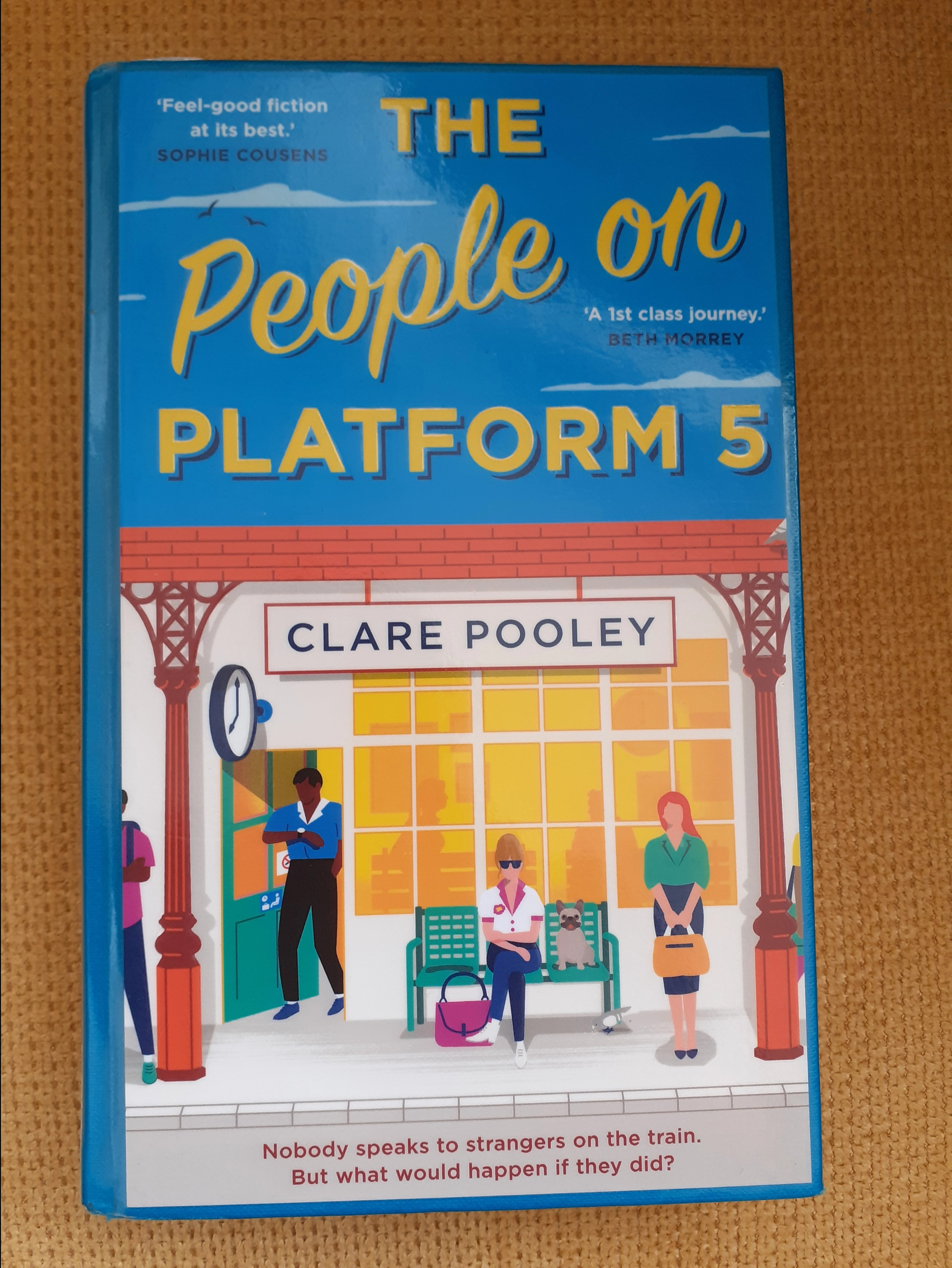
What a pleasure of a book this is! The book starts with an image of the Hampton Court-Waterloo Station line in London that handily mentions which character boards where. I appreciate any drawings, maps, charts, and family trees, in the front of a book as it makes the reading experience a lot easier. I do not like having to leaf back pages to remind myself of what or who.
Anybody who has ever had to commute for study or work, recognizes the premise: after a while you start to recognize the people that board the same train/bus/metro/tram/ferry as you. And because you don’t know anything about them, you give them nicknames. I often find myself on the same metro as “Gel head” (overdoes the slicked back hair), “MC Hammer” (once randomly carried a hammer with him), and “Justin Bieber” (due to the overuse of the word ‘baby’ when on the phone with his girlfriend). I don’t know these people but recognize them. They surely recognize me as well and probably have a nickname for me too. The weirdest thing is bumping into these people in places other than the metro because that’s when I realize they have lives outside of the commute as well. And that’s exactly what this story is about: commuters getting to know each other, taking their friendships off the train and into real life. This book was also published under the title Iona Iverson’s Rules for Commuting. This makes sense because Iona clearly is the main character. She also is the first to board the train. Iona doesn’t travel alone, she always carries dog Lulu with her, and a bag that contains not just a thermos filled with tea, but a cup and saucer as well. (One of her rules for commuting relates to being equipped for any possible happening, and enjoying a cup of tea is a happening.) Martha refers to Iona as The Lady with the Magic Bag. Piers calls her Crazy Dog Woman. And Sanjay has nicknamed her Rainbow Lady due to the colorful outfits she wears. Then something happens which sees them breaking the don’t-talk-to-strangers protocol. And when that happens they quickly learn that there is more to their fellow commuters than meets the eye: everybody has a story. Iona is a magazine therapist (don’t call her an agony aunt), and although the people at work think of her as outdated and aged, Emmie, Sanjay, Martha, Piers, and David, start to share their problems with her on the train, and she gets to help them in real life, providing them with advice and suggestions. She dives into her role of match-maker and problem-solver, and the talks with the youngsters are give-and-take they make her better at work as well, and suddenly her columns are making headlines. Ever since hitting the fifty mark, Iona felt herself become increasingly invisible to the world, so revitalising her career and having people around her eager to listen, appreciating her opinion and experience, is doing wonders for her self-esteem. The story is difficult to describe further without giving any spoilers, so I’ll just leave it at this and only will tell you to get your hands on this book if you’re looking for something enjoyable and fun to read, that will restore your faith in people on public transport.
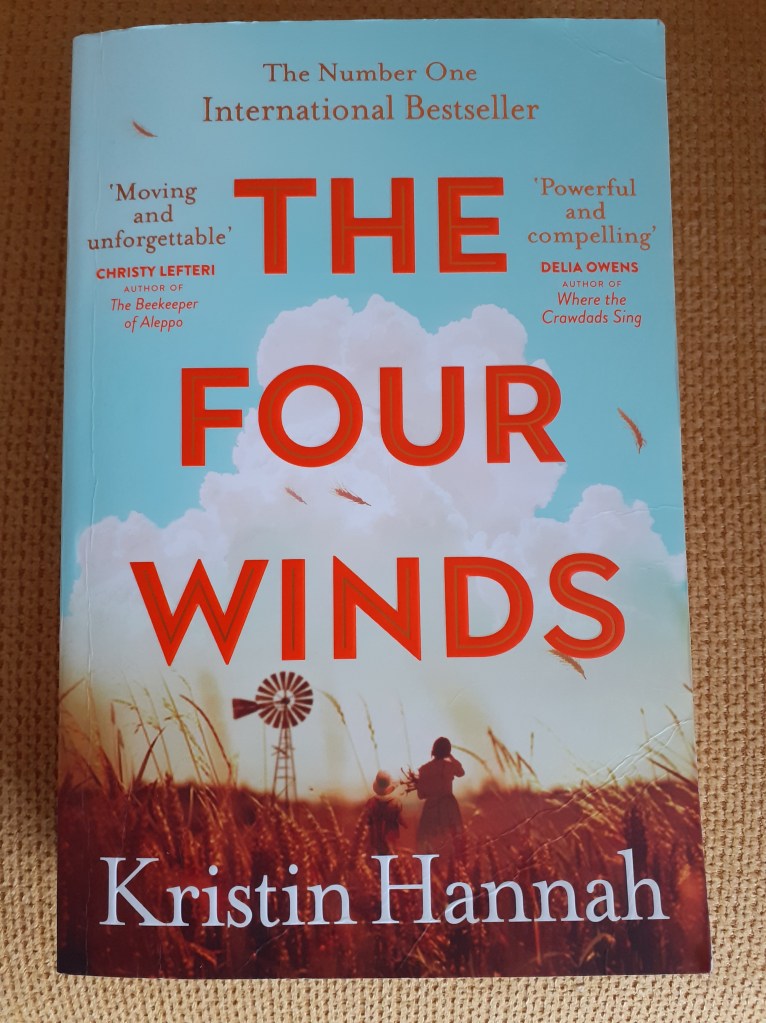
No. 15: A book I own but never read The Four Winds / Kristin Hannah
Let’s be honest here: the number 15 slot is the wildcard category of this year’s reading challenge. With a tbr that is no longer a pile, but a cabinet full of books, I was spoiled for choice, but The Four Winds was the one that jumped out at me. Well, not so much that, as that I remembered I had it, because the author just published a new book (The Women) that I’m eager to read and I figured it’s only fair that I should read the oldest one first, so, I picked up The Four Winds and dove in.
This book takes place between 1921-1936, in rural Texas. History teaches us, that the time and place combination is not exactly the best one, and immediately, Steinbeck’s Grapes of Wrath came to mind, a book I loved so, so, much. I think this is why I was hesitant to get started on The Four Winds: what story could compete with that? It turns out, this one comes very, very, close. Born into a well-to-do family, Elsa grows up in town. As a child she caught a serious fever, and after that, she’s been held back by her family under the claim of a weak health. Elsa realizes though, that her family mostly think she’s not pretty enough: she’s tall and skinny, and at twenty-five considered a spinster. With that label, her life has been mapped out for her, but it’s not a map that Elsa likes. She wants to live. So, one Saturday night she leaves the house and goes out to do just that. It lands her in more trouble than she could have thought of, and she’s kicked out by her family. With no other options or means of survival, she agrees to marry Rafe Martinelli, and settles into life on his parents’ farm. The transition from town girl to farm girl is easier than expected. Becoming part of an Italian-American immigrant family just as well. Converting to Catholicism also is no problem for Elsa. Getting her husband to love her though, is a lot more complicated. Life on the farm is a tough but good life which Elsa enjoys. While Rafe dreams of the glitter of Hollywood, Elsa dreams of sending their daughter Loreda to college, and her in-laws dream of passing on the farm to their grandson once he’s old enough. The farm prospers and they manage to buy extra plots of land and expand. Until the drought sets in, and life becomes a struggle. There is a big decision to make: stay, or leave for greener pastures. Elsa, along with her in-laws, is team stay. Rafe, and their teenage daughter, team leave. Rafe has never liked farm life, and wants to leave so badly that he eventually does so without telling anyone, hopping onto a train west. The rest of the family is stunned by his action, but buckle down and try their best, battling dust storms that are getting more and more severe, foreclosure on pieces of land, and the loss of ever more animals. Every day, people in their area are forced to give up, pack whatever they can, and make their way west. Elsa and her in-laws are too realistic to believe the talk of jobs that are supposedly available in California, nor do they believe in the tales of the “land of milk-and-honey”. But there comes a point, where they realize that there no longer is a decision to make and there only is one option left: for the children’s sake they cannot stay. Elsa and the children have to leave. Her in-laws remain on the land, hoping that their stubborn refusal to succumb will pay off in the end so that the family will have something to return to. Elsa hates leaving the place she came to call home, the people who treated her with love more than her own parents ever did, but forces herself to be brave for her children’s sake. She knows they are lucky enough to have a truck and money to provide it with gas. Years of drought taught them to be as careful as possible with money and means, but they soon learn that life as an immigrant in the west requires a whole new level of survival skills. Although she was realistic about the opportunities in California, Elsa is still shocked at the disdain and unfairness with which they are treated, and the hardship they are facing. But standing up for yourself is difficult when you feel like you have no voice or your voice is systematically ignored.
This was a page-turner of a book that I couldn’t stop reading. The struggle of survival, and facing the massive decision of leaving what you know, the place you call home, for the unknown, is well-written: the ever-present doubt about the decision made, and what to do next. People have been driven to be on the move throughout the ages, and it is happening today, and will happen tomorrow. That makes the story relevant, and easy to relate to, even though it takes place some ninety-odd years ago in a far-away location. The Grapes of Wrath made such a big impression on me, that, for me, it remains the number one story on the subject. But, The Four Winds is a solid very close second. The female perspective gave it a different view; a mother’s love for her children providing the strength needed to survive and make decisions. When the going gets tough, is when we get to know ourselves, and others, best. Elsa grew up believing she wasn’t strong or loveable, but she turns out to be stronger than most, and deeply loved by those who know her. She dares to defend her ground and stand up for the people she loves, providing an example for her children. I encouraged Elsa, cheered her on, and cried for her.
I’ve recommended this book to several people in the short time since finishing it, and now have a waiting list for my copy. I can’t say it enough so I’ll say it here as well: if you want to read a great book that’s about family, love, sacrifice and destiny, you should read this book.