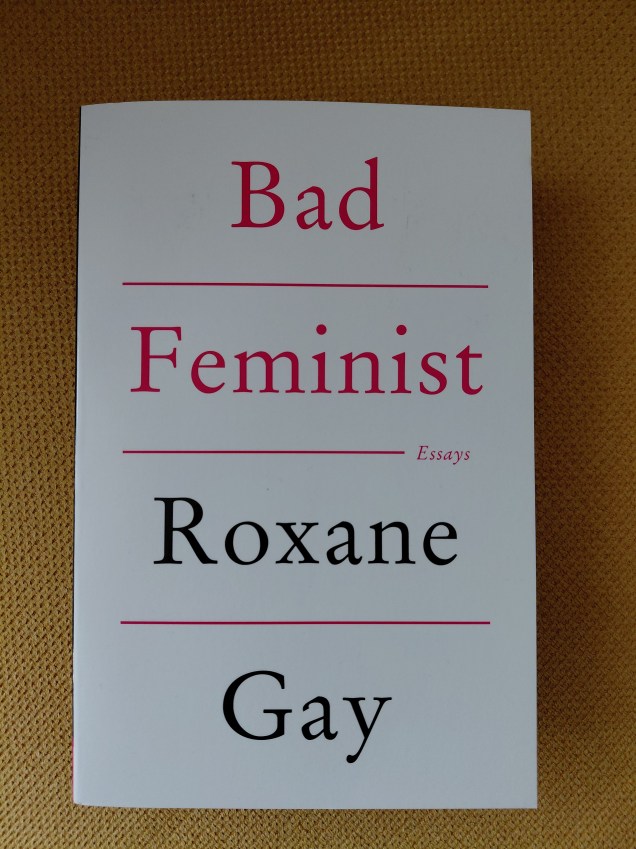
Bad feminist : essays / Roxane Gay What it is: Everything Did I like it: Yes
This category was suggested by Mtckc9df6533c2 and involved some homework for me in order to find a filler. But, success! Because I found that Roxane Gay gave a TEDtalk based on her book Bad Feminist. That title was enough for me to run to the store to get my hands on a copy.
I have been talking about this book everywhere: in the waiting room at the doctor’s office, during lunch, over drinks, and on my way to the airport. This book is Everything and I cannot believe it had escaped my attention until now. It was first published in 2014 and although you can tell that from the pop cultural references (sadly there would be space for more recent examples), it is still fresh, and unfortunately very relevant. The book is about privilege more than it is about feminism, and it covers racism and sexuality as well. So yes, if you are a woman, a person of color, or queer, there will be some or a lot in this book that you can relate to, but the often funny, sometimes painful, anecdotes and examples are there to create privilege awareness more than anything. And although it’s very American, it still translates well to other western cultures. The book covers just about every topic, from education, pop culture, rape, to scrabble tournaments. Some essays have anger coming off the pages and others are heartbreaking. The book did what it was made out to do, and made me think and consider my own thoughts and behavior at some points. At others I just laughed because it was so funny or recognizable.
I watched the TED talk first, then read the book. And then re-watched the talk. If you’re not into the book, at least watch the talk. It’s only 11 minutes-and-a-bit and is a perfect summary of the book. Thank you to Mtckc9df6533c2 (is it okay if I refer to you as friend M from now on?) for providing me with this category for the reading challenge; I’ve enjoyed it very much!
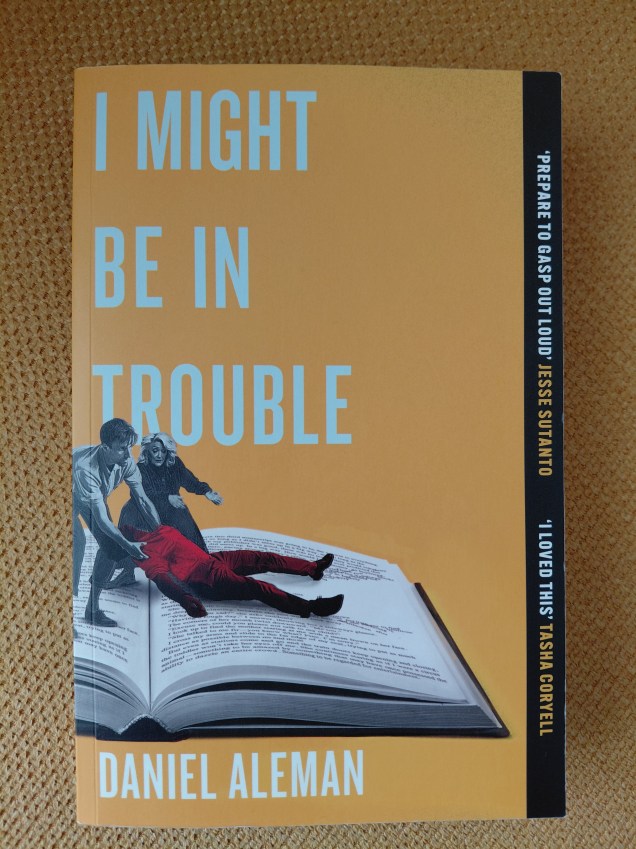
I might be in trouble / Daniel Aleman What it is: a Matryoshka doll of a story Did I like it: da
I found this book in the bookshop and even though I didn’t think it fit any category of the new reading challenge, I was too tempted and bought it anyway. Because I was desperate for it to fit a category, I checked the author and found out it’s registered as his debut adult novel, after having published two YA books. A debut is a debut, so here we are: first category of this year’s reading challenge checked! This category was suggested by GR via email. Thanks, GR, for making me discover a new author!
I might be in trouble is a darkly funny story about David, a struggling author who wakes up next to a dead body. It’s not any dead body, it’s that of the man he went out with the night before. It had been the best date in a long time and he had high hopes to develop a relationship but that’s all come to an abrupt ending. The obvious thing to do is call the police, but David spirals out of control, and instead calls his literary agent, Stacey. Stacey is a tough lady who had several of her husbands die on her, and she has edited several detectives and murder mysteries, so she knows stuff. And so, they decide to bring the man back to his hotel room, where he can be found by a maid. High jinks commence but it’s not just an update of Weekend at Bernie’s if that’s what you’re thinking or fearing. Because, when David wonders out loud how he’ll ever get over what they’re doing, Stacey calmly suggests he writes a book about it. Although hesitant at first, David cannot focus on anything else and so he starts to write the story of twenty-something Daniel, who wakes up in bed next to a dead body.
Between the high jinks and the new book, the story dives into David’s personal life, focusing on the relationships with his family and his ex-boyfriend. This part of the story creates some much-needed character development but it also at times slows the story down. What drives the story more than anything is David’s anxiety, and although it was well-written, if you’re not an anxious person reading it, it takes away a lot of the tension. The blurbs for this book had me go in with high expectations and for me, the story doesn’t quite meet up to those; it didn’t make me gasp out loud, and I don’t think it’s a thriller, page-turning or not. I do think the setup was solid and I found it to be an entertaining and fast read.
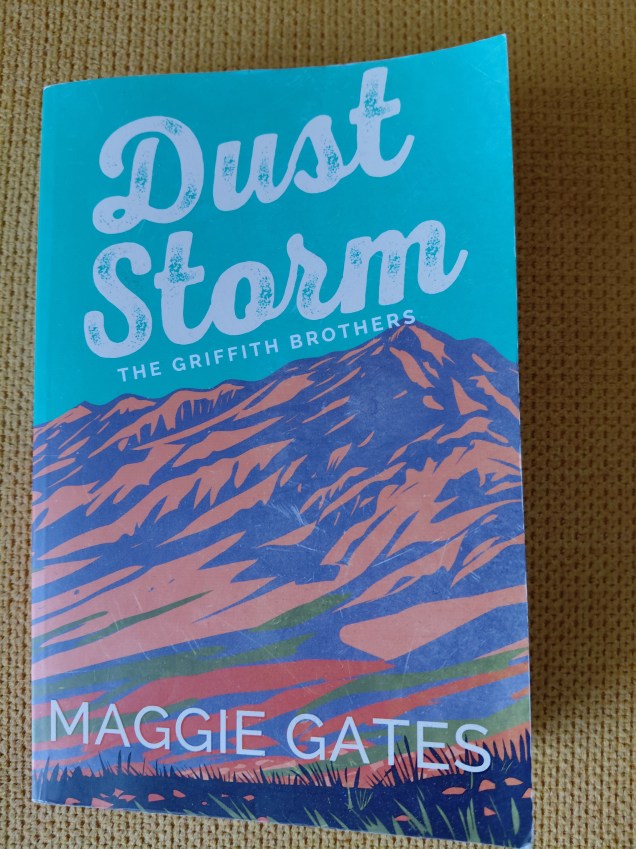
What it is: contemporary romance with a content warning Did I like it: it wasn’t for me
For months I’ve been trying to remember when, where or why I bought this book. My best guess is a train station bookshop by lack of anything else from my wish list or within budget available because contemporary romance is not something I veer towards and the summary on the back isn’t the most intriguing. It turns out I can not only surprise or scare myself, but confuse myself as well. But, as we all know, there is a time for every book and it came in handy during my first week of commuting to and from the new job. A new job comes with a lot of new information to process and a light and fluffy read during the commute allowed me to give my brain some much-earned rest to compensate.
The book starts by warning the reader about the adult content (something I had never seen before) and it wasn’t for nothing because this story contains a plenty of that, so I’m following up with a warning of my own: if that’s not your jam, don’t bother with this book. Ignoring the language part, the story was..hm, sort of okay. It contains multiple tropes from the romanceverse: opposites attract, grumpy-vs-sunshine, and fish out of water. Main characters, and telling the story in present tense in alternate chapters, are Christian and Cassandra. Cassandra has a type A personality, lives in New York City where she enjoys a high-flying career in publicity that includes mingling with celebrities and fashion designers. An incident sees her demoted to working corporate accounts only, starting with a cattle ranch in Texas. Her boss, who is also her fiancé, drops her off on the ranch before he flies off to Spain to take over her former client. Messy. The ranch belongs to the Griffith family, and super mellow Christian is its general manager. He is a widower and father of two young girls, and doesn’t hold back on his opinions (even though he doesn’t like it when people tell him theirs). Within two minutes of meeting, he tells Cassandra that her fiancé is an idiot and she should dump him. Thinking that is one thing, but to basically tell someone you literally met minutes ago and don’t know at all, that they are making bad life decisions is pretty rude. And it doesn’t stop there; Christian is also absolutely adamant that a woman riding in his car is not allowed to open the doors herself. On multiple occasions he makes his daughters and Cassandra go back in the car, shuts the door on them, and then makes them wait for him to open it. It’s probably well-meant but it made me itch as it read more about dominating women to me than chivalry. As the trope predicts, Cassandra is a fiercely independent woman who doesn’t like being told what she can or cannot do. Cassandra doesn’t like people, especially children, nor pets. So, moving into the house with Christian, his daughters, dog and pet cow, because the guest house is flooded, is her personal nightmare. Christian doesn’t like the way Cassandra talks to his daughters (as if they are adults), even though the children find it refreshing and like her for it. Cassandra, the daughters, and I were annoyed by Christian’s closed-mindedness.
The story has something to do with future proofing the ranch but it’s mostly about how Cassandra and Christian are opposites that attract. It seemed that Cassandra was the one doing the growing, as she was also the fish out of water, and Christian tended to be a bit of a bully with her which is why I didn’t like him. Then there was a big incident involving one of Christian’s brothers which causes him to break down, revealing some unexpected and oddly timed (too close to the end of the story) revelations about his personality. The incident with his brother is also something that kicks off another book and I wonder about the timelines of these stories, where and how they overlap. (Although I’m not curious enough to consider reading it.) Then to add to the oddness, the epilogue is in two parts as well, one from each of their perspectives, taking place eleven years later. It was such a big jump in time and it didn’t really add anything for me. Especially with romance novels I always question the use of epilogues anyway, because if one thing is for certain, it’s that there is a happily-ever-after.
All in all this book was okay enough to keep me entertained on days that I didn’t have enough brain cells available for anything else. If you like reading spicy contemporary romance this might be just for you (and if so, don’t forget to check out the other titles in the series), but for me, the kids and animals were the best parts of the story and I was keen to move onto something new as soon as I finished the last page.
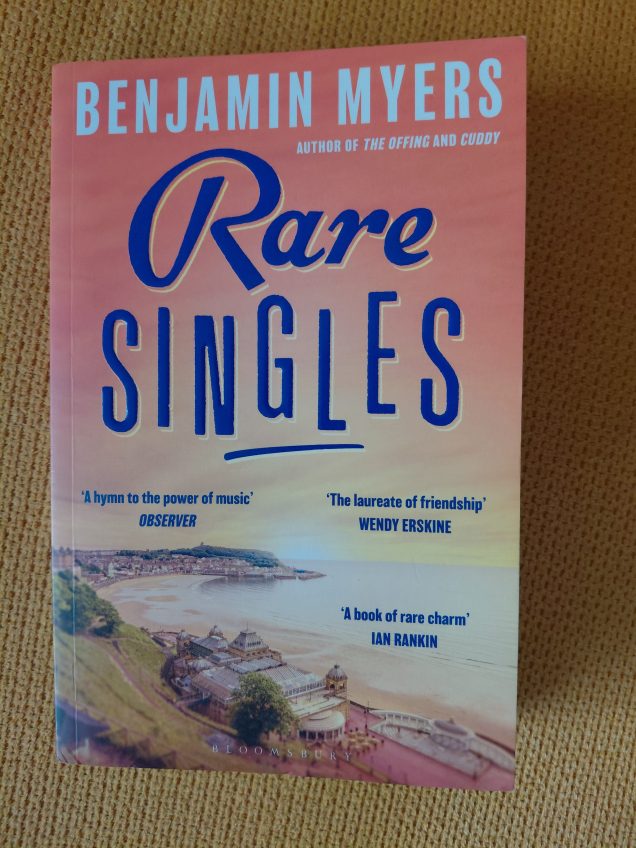
What it is: a story with a lot of soul Did I like it: oh yeah
This is the last book I started last year, as part of the 2025 reading challenge due to the blue letters of the title. It doesn’t count anymore, so it’s just a review now. I had bought this book specifically for the reading challenge and I recognized Scarborough on the cover. Then I realized I had read another book by this author, The Offing, which I remember as a very quiet story about self-discovery and growth. This book is different, yet there are comparisons that can be made: there are two main characters with a big age difference, it’s about self-discovery and growth as well, and both stories are set on the Yorkshire coast.
Rare Singles is set in Scarborough where Dinah is living her not-so-best life. She works as a checkout lady, is deeply unhappy about her personal life, and only cares about the weekends when she gets to enjoy soul music at a local club, as part of the Northern soul scene. She’s a massive fan of Bucky Bronco and asks him to travel to England and perform at the club for the last soul weekend of the season. Bucky Bronco lives in Chicago where he is surviving, just about, and not exactly living. His wife has passed away and all he is left with, is a crippling addiction. When he receives an invite to do the show at a club in Scarborough, he’s stunned to discover people not only remember him, but still love the one song that he had released five decades before. He decides he has nothing to loose, and gets himself on a plane to England. Bucky has never travelled outside the US and his musings about northern England are fun to read. Just like Dinah and Bucky, Scarborough’s glory days are a thing of the past and the setting felt like a proper third main character to me, especially the way it is seen through Bucky’s eyes. The story is set in just a few days, but covers a lifetime. I really enjoyed Bucky as a main character, he is the star attraction in more than one way, and Dinah is his loyal second-in-command. There are discoveries made, mostly about personal growth and development, and I think this story can easily be made into a movie. (Actually, it totally should! The soundtrack would be awesome.) At just over 200 pages this is not a big read at all so even if you don’t like big books, or want to travel light, book-wise, this comes highly recommended!
The librarian of burned books / Brianna Labuskes What is it: women fighting ignorance Did I like it: of course I did
Librarians are awesome and as such make awesome characters in stories. And although I’m not-so-slightly biased, it’s also a fact that every genre has books with librarian protagonists. I’m now kind of curious about books with librarians as the baddies; if you know of any, kindly let me know in the comment section. Something else: starting in the new year, I will no longer be working as a librarian as I’m moving to a new and exciting position outside of the library. I have a feeling there are a lot less books about civil servants in office jobs available, but if the catergory ever pops up in a reading challenge again, we’ll find out about that.
Onto the book! This story is set at three different places and times and features three different women. Althea, Berlin, 1933. Hannah, Paris, 1936. And Vivian, New York, 1944. What the women have in common is that they love books deeply, they don’t understand the banning of books, and they refuse to back down from men or general opinion. Althea is a published author from rural Maine, and she has been invited by the Nazi party’s propaganda machine to come to Berlin on a scholarship. She loves being in the big city and is swept along on the wave of NSDAP events, taken by a handler appointed to her to make sure she doesn’t miss anything. Hannah is a German Jewish refugee in Paris and has experienced firsthand how damaging the Nazi ideology can be as her brother was arrested in Berlin for his political beliefs. After that, Hannah and her parents fled to Paris for safety. Hannah works in the Library of Banned Books which stands to promote Jewish culture. She also spreads political brochures and uses her Berlin experiences to warn her Parisian friends. Over in New York, Vivian has lost her soldier husband and is working in the Armed Service Editions; an organization that sends special small edition books to the troops overseas. Vivian is enrolled in a vendetta against a senator who wants to impose a ban on books, which includes a ban on this particular service. Each of the women has a personal reason to become an activist, and their stories are equally well developed. The women each get the same amount of time on the main stage, resulting in three equal main characters.
I must admit it felt like this was one of many of kind-of-the-same books I had already read: The banned books of Berlin, The librarian spy, The last bookshop in London, The Paris library. Their covers look alike, and their stories have similar topics and set-ups. It got to the point where I thought I had bought a book I had already read because even the synopsis on the back didn’t clear things up enough. I guess we can safely conclude that I’m a sucker for books on librarians and books, especially in a historical setting. What sets this book apart is an lgbtqia+ angle. I think these books are popping up in big numbers because a) I’m not the only sucker for them and b) book banning has unfortunately become a hot item again and the best example for how bad that situation can get, is the Nazi-example. All in all, this book was an easy and fast read and I really enjoyed it.
Saltblood / Francesca de Tores What is it: an adventure like no other Did I like it: aye!
To be honest, of all the categories left on this year’s reading challenge, this was not the one I saw being filled before the end of the year. But, life is unpredictable and so is my reading. This book was brought to my attention (and borrowed from) friend M and sheesh, was I happy about that. This book tells the story of Mary Read. History knows her for two things mainly: she was a pirate, and she dressed like a man. I only knew she was a pirate, so I had a lot to learn. The story reads like a classic adventure and halfway through I had to remind myself that Mary was a real person; I completely got swept along with the story.
In the late 17th century, Mary is born as her half-brother dies. This leaves her mother with a problem because along with Mark dies the inheritance money he received. So, Mary is turned into Mark, making it possible to keep collecting money from his grandmother a couple of times a year. Mary learns to walk and talk like a boy and because she can pass, she is sent into service as a footman once she looks old enough. Her mother tells her to keep up appearances, because it is safer to be a boy than it is a girl, and boys earn more than girls. (Depressing how little has changed in 300-odd years.) After a few years, Mary makes her escape from the stifling stillness of the house by way of enlisting in the navy, and while the other boys who are enlisting add years to their age to earn more, she shaves a couple off to explain her smaller figure and higher voice. She finds her calling in the navy, enjoys her time aboard the ships more than anything, even though it is a dangerous place to be found out as a woman. After a couple of years at sea, she moves to the army and is sent to the battlefield. The longer she spends on dry land, the more she misses the sea, and she’s desperate to survive her enlistment so she can return to the water. When she does have an opportunity to return aboard a ship, she no longer hides herself and presents as a woman. The merchant ship she works on, finally ends up in Nassau, the Bahamas, the pirate capital of the world at the time. Here, she meets Anne Bonny, and is mesmerized by her. Anne at the same time, is intrigued by Mary, who learns she herself is something of a legend, known as the “sailing woman”. When she has the chance to join a pirate crew, she takes the opportunity with both hands and realizes she never felt so free before. She’s an equal member of the crew and as such gets to earn as much as the men, gets to vote, and is appreciated for her knowledge of sailing and dealing. It takes being a pirate to be considered equal. But piracy isn’t a career that offers longevity and there is a dark cloud hanging over the story. And wow, what a story. The story is about gender, about survival, about making choices, about discoveries, and about an incredible woman. And the wonderful writing only added to it and left me turning page after page after page. I was so into this book, that I missed my stop on the metro, and I didn’t mind one bit as it gave me extra time to read as I made my way back. If you want to read an amazing adventure story that features strong main characters, this book needs to be added to your read-list.
The bookshop ladies / Faith Hogan What is it: a cozy read Did I like it: I sure did
The story kicks off in Paris, which hasn’t been a small town for many centuries, but then quickly moves to Ballycove, Ireland. Having lived in Ireland, books set there always make me happy, even the dark and heavy ones. This book is warm and cozy and made me extra happy.
The first chapters introduce the three different characters: Joy, an American woman living in Paris, Robyn a young woman living in Ballycove, and Fern, a young artist breaking through in the art scene with a show at a fancy gallery. When Joy’s husband dies, he uses his dying breath to reveal a big secret. Deeply upset, Joy has her world turned upside down and is unsure of how to move on. When she learns that her husband left a painting to someone living in Ballycove, Ireland, it gives her something to focus on and she wraps up the painting and travels to western Ireland. In Ballycove, she finds Robyn who owns the only bookshop in town. Running a bookshop has been Robyn’s dream but she’s a shy bookworm, more likely to sit reading in her store than actually running it. Realizing she needs help, Robyn puts up a sign asking for volunteers. When Joy enters the shop, she is mistaken for an applicant and accidentally talked into accepting the non-paying job. By the kind of coincidence that only happens in books or movies, Joy has had a career in bookshop marketing, and she knows what she’s doing. She’s happy to be back at work, and she brings the kind of energy that isn’t overpowering but allows Robyn to grow into her own as a businesswoman. Then Fern arrives as well, and soon the three of them become a team. But there are some secrets lurking in the background and when they are brought to light, it changes the team dynamics. With the big official launch of the shop only days away, it is bad timing and the three of them need to find a way to make things work or walk away.
The town of Ballycove sounds just lovely and there are some interesting background characters moving around, which I’m assuming might be popping up in the other books by this author. From what I could tell the books aren’t an official series, just mostly set in the same place, at least that’s what it reads like. The main characters are nice but have their flaws and show growth, and the setting made me want to drink coffee and enjoy the sound of seagulls in the distance. If you’re looking for a cozy read set in a small-town and or bookshop, you will like this one.
The Apple Pie Ice Cream Parlor: a Dream Harbor Novella / Laurie Gilmore What is it: special edition novella Did I like it: nope
This book was published to promote the Week of the English Book. Lucky me I got out of the reading funk and into a book-buying spree just in time to receive this little book along with the stack of books I purchased. As happy as I was with my other finds, I ended up reading this one first because of course. The Dream Harbor series is very popular, and I’ve seen the books everywhere. I hadn’t read one yet but that was no problem for this book; there is a handy map at the front of the book, (which I’m guessing is in all the books of the series), which greatly helped set the scene. A lot of characters pop up in this story that I figure have their own stories in the series. On the plus side, this helps build the world of an everybody-knows-everybody small town, which the limited space of a novella really needs. On the minus side, there’s barely enough space in a novella to create a believable storyline, especially when it’s about two people falling in love. To constantly have additional characters pop up, felt a bit cluttered at times. Even the main characters got annoyed at one point because they kept getting interrupted during conversations. Those main characters are Leo and Charlotte, both teachers, and best friends of three years. The story kicks off with them mid-kiss, something they are both shocked about. As they are both scheduled to volunteer at an event to raise money for the local fire station, it makes things uncomfortable to say the least, especially when they both end up scooping ice at the titular ice cream parlor. The kiss makes Charlie see Leo in a completely different light, and she can now only notice how handsome he is, how defined his muscles, and how delightful his voice, and is no longer able to have a normal friendly conversation with him. So far, I was able to keep up with the story and thought: at least it’s not as bat-shit crazy as last year’s book! But then the story turned on me. Charlie doesn’t know how to deal with her turned-upside-down emotions and instead of taking a step back and thinking things over, she proposes that they sleep together in a non-romantic way so they can get the feelings out of their system. There’s a backstory of her pink hair and piercings leading guys into thinking she’s kinky in the bedroom. It felt crammed into the story just to give it a bit more weight and backstory to the Charlie character but because the story is so short, it came out of nowhere and was solved way too easy. Leo’s backstory involves two affairs with two former colleagues so clearly teachers are his type. Their one night of non-passionate passion is followed by four days of pining and agony at work, and then they inevitably bump into each other outside of work because it’s a small town, have a chat and declare their love. The second half of the story definitely ruined it for me and I’m just glad this meant I got to cross out another item of my reading challenge real fast. Onto the next one!
The Apple Pie Ice Cream Parlor (A Dream Harbor Novella) / Laurie Gilmore
Shady characters : Ampersands, interrobangs and other typographical curiosities / Keith Houston What is it: all things punctuation and then some Did I like it: yes exclamation mark
Me: Everything I had ever wondered about weird symbols and punctuation is answered in this book. Friend C2: You wonder about punctuation? Me: You don’t‽
The foreword was an indication that the author and I wonder about the same things. The difference between us is that he couldn’t let it go and ended up with so much research that it could be bundled into a book, whereas I only had to buy his book to have my questions answered. I didn’t read this book because I’m a purist where it comes to punctuation, as anyone who is can probably easily tell from my writing: I throw in commas and (semi)colons where it feels right, rather than bother to investigate and make sure they are in the right spot. At best I use the Word grammar check to help me out, but the squiggly lines annoy me and often I’m not sure whether the suggestion is actually right, so I click “ignore this” way too often. My interest in punctuation is more the history of it, who came up with something and why, and what’s with the names of the symbols. This books covers it all and then some.
I learned about this book because articles about “stories hidden in your keyboard” are total clickbait for me. Fresh out of my reading slump, I skipped to the bookshop to get my hands on this read. And boy, does it deliver: the author did a deep dive into the pilcrow, octothorpe, and ampersand. If these names don’t mean anything to you, I’m sure you recognize their symbols: ¶ # &. These and other symbols each get their own chapters. I liked how the author put the symbols to use in the text, creating easy and clear examples. I’ve already memorized the code for entering an interrobang (‽ : a combination of an exclamation mark and a question mark) on a windows computer (alt+8253) and have probably been using it too often. The one thing I found annoying, but that’s a general pet peeve and not something particular to this book, is when the text of a footnote continues onto the bottom of the next page. It disrupts the reading experience, and I would prefer a footnote that is limited to one page, even if it were to take up more space than normal. Moving on. This book taught me so much about typography and editorial work, and I’m sure the book is a standard in those worlds, but it is a dream to read for grammar nerds and curious minds as well; there are plenty of images to illustrate topics, there is an index and a vast list of notes. It’s not boring at all, in fact, it’s rather entertaining; the chapters travel through time, from graffiti in Pompeii to Johannes Guthenberg’s printer to touchtone telephones and the first email. It is worth pointing out that the book focuses on Western writing and publishing. Bonus points for the wonderful title.
Shady characters : Ampersands, interrobangs and other typographical curiosities / Keith Houston
What is it: screwball detective Did I like it: so much so, that this was my third time reading
Stephanie and Lula are at it again: they’re chasing down skips for cousin Vinnie’s bail bond’s office and do so with more luck than wisdom. They are after Geoffrey Cubbin, who is out on a lots-of-zeroes bond for embezzling millions of dollars from an assisted living home. Cubbin disappeared in the middle of the night from the hospital where he was getting surgery, so that’s where the bounty hunters go first. The security manager at the hospital turns out to be Randy Briggs, whom they’ve met in previous adventures. Also looking for Cubbin, is Stephanie’s currently-on-again boyfriend, detective Joe Morelli. They bundle their forces for this search and it’s a lot of fun. Cubbin is not the only skip that Stephanie and Lula must recover; also out on a bond is Dottie Luchek, who was arrested for solicitation at a bar, and Brody Logan, a homeless man who took a hammer to a police car. Brody listed a religious item considered to be worth a lot of money for his bond but never turned it in. Now Stephanie and Lula need to get both Brody and the Tiki back, which proves a more difficult task than imagined. These smaller cases are the running gag for the story because aside from the Cubbin case, there is another big plot which involves Ranger. Ranger and a friend of his are both receiving death threats and Ranger asks Stephanie to be his bodyguard. Although there is a lot going on, the story reads smoothly. I like these books because the characters are a lot of fun, and it never gets boring. Of course, there’s a grenade shot into Stephanie’s apartment and there are several cars demolished in explosions. Grandma Mazur is all too eager to spy on behalf of Stephanie, and Lula wears bright spandex outfits and shares her knowledge on how to be a proper ‘ho with Dottie. The entire Stephanie Plum series is part of my comfort reading, and this book delivers as they all do; it’s fast and fun, and it got me back to reading.


 Bookworm in the City