I’m still here! My tablet broke down and I didn’t have the patience to create entries on my phone.
On the plus side: without a tablet there was no room for distraction and all the more time for reading. Expect some catching up soon!
Author: loesielou
Reading challenge 2024: No. 1
No. 1: A book based on a historic event
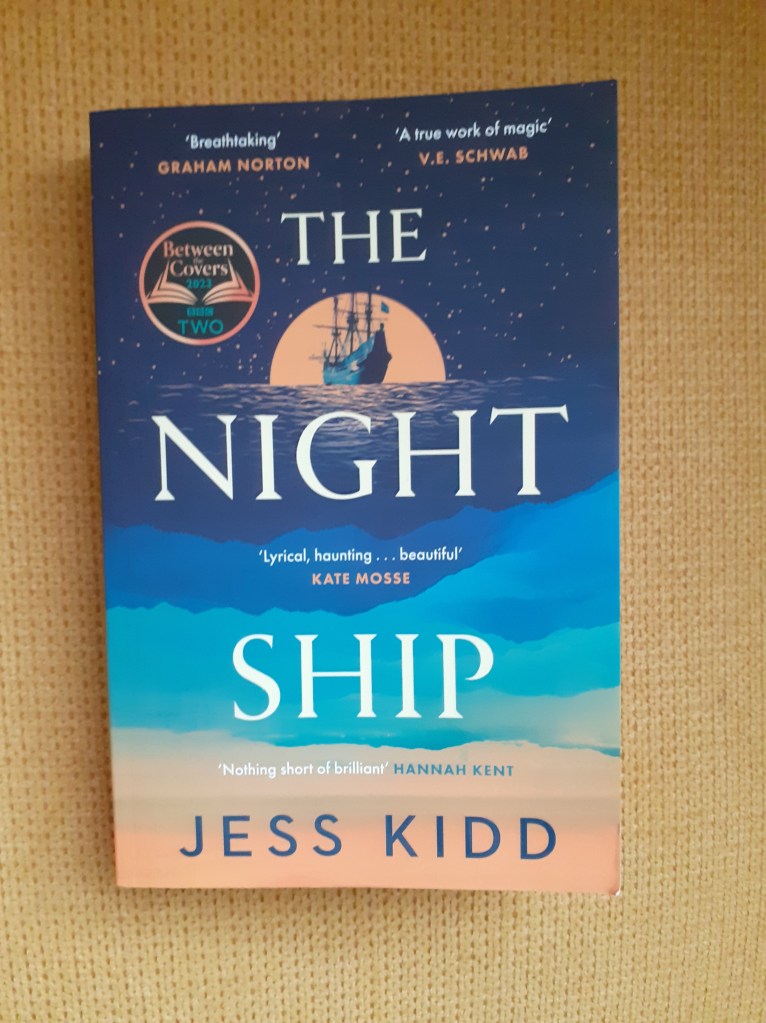
The Night Ship / Jess Kidd
I went from Dublin to Dublin in my reading, and now from magical to (slightly) magical. It’s all connected and we’ll see where it’ll end up. For this book, it’s Beacon Island.
There are two stories here: Mayken’s, which starts in 1628 when she boards the Batavia ship. And Gil’s, which starts in 1989, when he arrives on Beacon Island, a tiny island (you can cross it in twenty minutes on foot) off the west coast of Australia.
Mayken and Gil both lost their mothers due to unconventional / problematic lifestyles.
Mayken and Gil live three hundred years apart, but their stories are mirrored: both live in/on confined spaces, are free spirits, cross dress, run into stories about monsters living in the water, and neither wants to be where they are.
Although it’s probably best known in Australia and the NL, the story of the Batavia has been told in documentaries and books, so I don’t consider it a spoiler when I say that its 1628 maiden voyage didn’t go entirely according to plan. Loaded with riches, and people, the ship was part of a fleet of East India Company ships travelling to what was then Batavia, and is now Indonesia. The sailors were literally sitting on top of chests full of silver coins, and with a skipper and upper-merchant that didn’t get along, tensions started rising all over the ship.
The Batavia’s story is in the book, but told from Mayken’s perspective, which is that of a nine-year old girl. She notices the unrest, the tension, but doesn’t know what it means. Her focus is more on catching the monster said to be living in the hull of the ship.
Gil is also living with tension and unrest caused by frayed relationships between the different families on the island. He also discovers he is causing tension and unrest, just by being different. Both stories build up to explosions of violence.
This book is a historical with gothic elements and hints of otherworldlyness. The build-up is nicely paced: it starts by calmly setting the scenes, the children exploring their new surroundings and getting settled in. Then, as story grows more urgent, the pace picks up, faster, faster.
The story goes from hopeful new starts, to awful realities. The story of the Batavia is clearly well researched, making Mayken’s story a treat. I liked Gil’s story as much though, and was intrigued about the boy who, appropriately, and not coincidentally, gets nicknamed Gilgamesh.
The story being told from the perspectives of children, gives it a slightly eerie sense, and I liked that most about it.
This book comes with plenty of blurbs: four on the front cover, and five on the back. More yet, on the inside. That can be annoying, but in this case, I have to agree with all of them: this book sweeps you off your feet.

Book review: The Lost Bookshop / Evie Woods
I ended the year with a book that I’d bought in Dublin and I kicked off the year with a book that takes place in Dublin. It was by total accident, or maybe subconsciously I knew, but who has time to figure these things out? Onto the book!

The Lost Bookshop is a magical story about three different people: Opaline, Martha, and Henry. The magical part is quite literal so if you’re a bit more skeptical, then maybe this book isn’t for you. I do love a bit of magic every now and then, and thought this book did it very well with just enough of it.
In nineteen-twenty-one, Opaline is being told that she needs to marry. She doesn’t like the idea one bit, and defies her mother and bully of a brother by selling a few rare books from the family library to fund her escape to Paris. She soon realizes she needs a job, and stumbles into one at the Shakespeare and Company bookshop. Here she meets James Joyce, in the process of writing Ulysses, and Ernest Hemmingway, in the process of flirting. She also meets Armand again, a man she’d met on the ferry, who had prevented her suitcase being stolen.
In the now, there’s Martha, escaping an abusive relationship, and the Irish countryside, and starting over in Dublin. She finds a job as a housekeeper for an elderly lady, and the best thing about the job is that it comes with a small basement apartment. On the first morning there, she wakes up to the sound and view of pacing feet in front of her window. When she goes to yell out of the window, she discovers that the feet belong to Henry, an English scholar, looking to find a bookshop at number eleven. Except the only houses there are numbers ten and twelve. Just as the title puts it: the bookshop’s lost.
Martha has the ability to read a person, so she knows Henry is in love with another woman. She also experiences sentences popping up in her head without context, hears sounds in the basement apartment, and discovers tree branches growing into shelves on the wall, complete with books that pop up. She accepts these things as they come along, trusting her instincts and the good vibes of the place.
Henry has the focus on his research shifted when the funding of his project gets cancelled, and he travels home to England to rearrange things. Once there, he finds out that his father has been in rehab, and is really trying his best to stay sober this time. Having had an alcoholic father growing up, has however, left a dent in Henry. He’s not able to trust his father’s recovery, and is used to keeping his guard up.
Even though they don’t seem to have much, if anything, in common, Martha and Henry quickly connect and become friends. They bring out the best in each other, with Henry introducing Martha to learning and reading, and Martha teaching Henry to approach his research and problem solving, from new and different angles.
Slowly but surely, the two of them unravel the story of Opaline, and the different storylines start to come together.
Opaline, Martha, and Henry all experienced trauma and refuse to let it define them: they have painful pasts but know they can only move forward, and do so. They are able to re-open their hearts again, and love, and grow.
Aside from the magic-magic, the story contains plenty of book-magic. The characters appreciate books, and what they can bring a reader. It’s about the hidden stories inside a bookshop, the hunt for rare books, and a missing manuscript.
This book and I were a match made in book heaven, and I enjoyed every page of it.
Coincidence or magical interference? Last week I spotted an article in The Guardian about the Book of Kells and its new experience. Then a few hours after reading that article and texting friends about it, I was on the train, continuing my reading of The Lost Bookshop, and my mouth fell open when a scene happened where Henry takes Martha to Trinity College to see the Book of Kells. The way she describes seeing it for the first time, the experience of being in the library’s Long Room, made me smile because I could so relate to that. And I couldn’t believe the happenstance of reading about it, after reading and texting about it earlier in the day. “No way!” was my out-loud reaction to it (startling the woman sitting next to me).
The universe works in mysterious ways I’m not smart enough to understand, but I do believe it is telling me I need to go to Dublin.
Reading Challenge 2024
Oh yes, this is happening again!
New year, new reading opportunities. And I’m starting months earlier this year, so I have high hopes for a fully checked list by the time we reach end of December.
So, with the appropriate fanfare and glee, I hereby present: Reading challenge 2024!
- A book based on a historic event
- A memoir
- A book set in the 70s
- A graphic novel
- A book I started but never finished
- A book set in the future
- A nonfiction book
- A book with bad reviews
- A book set in my country
- A book published this year
- A book with a number in the title
- A book written by an author with the same initials as me
- A book set during a holiday
- A book that is set in the decade I was born
- A book I own but never read
- A book with a green cover
- A book with an antonym in the title
- A book everyone is talking about
- The title starts with M
- A book with a body part in the title
- A book with a verb in the title
- A trilogy
Anyone else doing a reading challenge?
Happy 2024!
Or: Looking forward to a new year or reading
There will be love and heartbreak.
There will be war and peace.
There will be tears and laughter.
There will be moments of quiet reflection and wild jubilation.
There will be I-can’t-believe-that-happened moments, and obstacles to overcome.
Opportunities, conquests, and robots.
The books will have all this as well, and then some.
Wishing you and yours a happy and healthy New Year, filled with wonderful stories.
‘Tis the season
Or: 2023 – Looking back on a year of reading
The days are dark and dreadful, literally and figuratively, and I’ve happily drawn the curtains to block it all out. Here, in my personal bubble of books, booze, music, and absolutely no news, I’m looking back on the year in reading that is now almost entirely behind me. This is, after all, the time of year where we look back and reflect. So, let the evaluation commence!
The Reading Challenge
- 17 of 25 boxes ended up being checked, which is a result even I didn’t see coming, as I only started the challenge in May. My willingness to drop everything in order to read, has finally paid off!
- The worst book I read for this list was definitely no. 13 – a banned book which had me in a spin for a bit. And then I didn’t finish it. It’s also with great pleasure that I can announce that this is hands down the worst book I ever attempted to read.
- The biggest disappointment in a book was no. 5 – a book with a person’s name in the title. I was so enticed by the teasers and the cover page, and then I just didn’t get it. It happens.
- The biggest stand-out ends up a triple tie between numbers 14 – a western, 20 – a book that prominently features an animal, and 6 – a book that was turned into a movie. The western was just a thrill-ride that sucked me in from the very first page, and the animal I read about, was a delightful octopus named Marcellus. Then there was scientist Elizabeth Zott, who figured if cooking on tv was the way to get her science across, then that was what she would do. Three very different books, but the common denominator was a kick-ass main character with an amazing voice.
- The biggest surprise about a book was no. 10 – a retelling of a classic just because I was fearing a dry and complicated mythical read, and then it turned out to be a delightful, almost Dickensian, tale of love conquering greed and envy.
- Books I learned the most from, are numbers 8 – a book with a one-word title, and 4 – a book with a city in the title. My entry-level knowledge of John Wilkes Booth was what I had learned through tv-show Timeless, but now I know enough to take a quiz on the guy. 1950’s Iran was something I knew equally little about, but reading a story set in that time and place, had me doing a deep-dive into the history books (and recipe books, because the way the cooking and the food was described, had my stomach growl).
- The book I laughed the most about, was easily no. 22 – a book with more than 500 pages. Fucking stuff up is part of life, no matter what age you are, and I really enjoyed the way it was described that Nell came to that realization.
Other reads:
Yes, I probably would have finished the reading challenge if I only had stuck to reading items that fitted the list. But, sometimes books that don’t fit a category, still had to be read: they were either borrowed from friends, I was the next reader on the library waiting list, or they just called out to me from their spot on the to-be-read pile. Then I also re-read some of my all-time favourites, just to get me going again when I got stuck in a reading rut or needed something to get me away from a book.
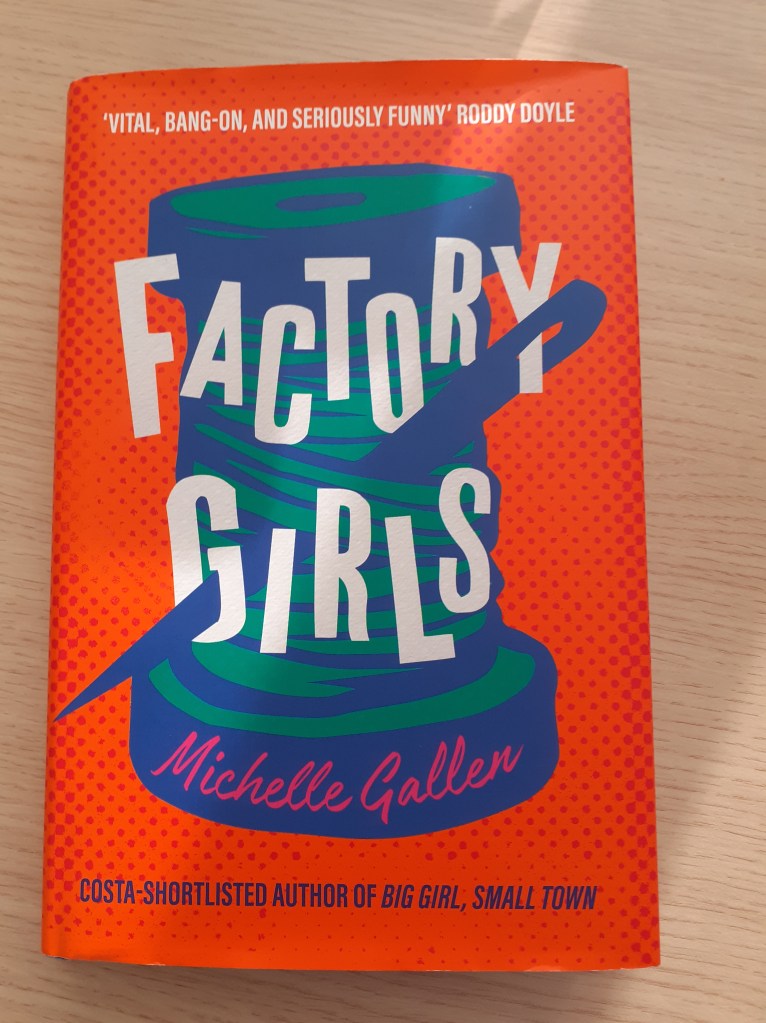
How to kill men and get away with it , Everyone in my family killed someone, and Factory girls were the stand-out reads in this category. I’m sure it’s entirely coincidental that these three books all have bright orange covers.
In numbers
- 31 – total number of books read that fell outside of the reading challenge category and/or were read before the reading challenge was started.
- 17 – total number of books read for the reading challenge
- 7 – books started but not finished because they were the wrong book at the wrong time
- 27 – books I borrowed from the library
- 5 – books I borrowed from friends
- 23 – books I bought
Overall conclusion
I borrowed books, bought books, and donated books.
I’ve talked about books, written about books, and took so many pictures of books-i-want-to-read that my phone’s memory is close to reaching full capacity.
I got to know amazing characters, and discovered new places.
2023 was one heck of a book year.
Book review : Factory Girls / Michelle Gallen

My tbr pile is so big, that I lost a book in there.
(Confession or brag: it’s a thin line. I guess it depends on who you ask. Just don’t ask my mom: she’ll only roll her eyes.)
What happened, was that I started to read this book last year, and when for some reason I had to put it down, I accidentally put it on the wrong stack and it ended up on the tbr pile, instead of the “I’m currently reading these”-pile. When I was looking for a book to read for my reading challenge, I stumbled on this book instead, was so happy to have found it again, that I forgot about the reading challenge for a hot minute, and dove into this instead.
I bought this book in Dublin last year as a souvenir, and it’s very Irish.
Factory Girls is set in Northern Ireland, 1994. It’s about Maeve Murray, who has two best friends, Aoife, and Caroline. They live in “a shitty wee border town” near Derry, and the girls have just finished school. They have all summer to wait for their exam results, and use the thirteen weeks to work at the local clothing factory, to save up money for university. Maeve dreams about studying journalism in London, where nobody will know her, and nobody will care about the fact that she’s Catholic and has a sister who died.
Because they can’t wait to leave home, Maeve and Caroline rent a small apartment above a shop, across from the factory. The factory workforce consists of Catholics and Protestants alike, and even inside the small factory community, there is a strong divide that has tensions rising at times. The peace talks that are happening, are only cause for more tension. Maeve is relieved to finally find one thing they have in common: both Catholics and Protestants sing the happy birthday song exactly the same.
Their boss is Andy, who is called Handy Andy by the workers. He’s a creep who unhooks the women’s bras as he walks his rounds on the factory floor, and regularly calls women into his office alone. Maeve becomes one of his victims, but when she finds out she’s comped an extra ten pounds in her weekly pay for it, she only cares that in thirteen weeks, that would add up to an extra hundred-and-thirty pounds.
It is Andy who gives her the book How to Make Friends and Influence People which she applies in the funniest and darkest ways.
Maeve is aware that survival in their corner of the world, depends on being able to stay out of the spotlight, to keep your head down, and not make any outspoken friends or enemies. Yet just as she is about to make a clean get-away, she breaks her own rules and gets herself into trouble.
The book is written in accent, and I don’t know about you, but I generally find reading accents difficult, it slows me down, and words or expressions can leave me stumped, or require reading out loud. But when accent writing is done right, it adds an extra layer to the characters and the setting. I thought this book was an excellent example; the accents are used to mark the difference between the standings in society, and I could just hear these girls talk. And Maeve talks the best talk. She’s rough around the edges, a sharp observer, and aware that her working-class, Catholic background, is not working in her favour. Maeve is also aware that her normalcy about living with terror all the time, is actually not normal. Not only has she witnessed, and experienced, the violence of the Troubles, but plenty of “normal” violence and sexual abuse too. As she says: life is tough on men, but it’s always tougher on women.
Despite its serious setting and the roughness, there are plenty of (dark) laughs to find in this book as well.
This book gives off Derry Girls vibes (if you haven’t seen it: this is a gem of a show that streams on Netflix in the NL, not sure about other areas) but it’s way more real than that and has a darker sense of humour.
I liked this book a whole lot and it is a perfect example of why books make excellent souvenirs.
Sick
You know you’re sick when you don’t feel like reading.
All better now, but some serious catching up to do.
Rant or review
Book review – The Little Bookshop On The Seine / Rebecca Raisin

Boy-oh-boy, do I have things to say about this book.
After all the happy-sigh reviews, and, I admit, the pretty covers for the different editions, I had such high hopes. Bookshops. Paris. Christmas. What could go wrong?
Unlikeable characters, that is. You can have the nicest settings but if the main characters aren’t appealing, it drags down the story. And not be a total grinch, but the minor characters didn’t win me over either as they never really seemed more than stereotypes.
Ye be warned: I’m in no mood to hold back so spoilers ahead.
The story goes as follows: Sarah is the owner of a bookshop in small-town America.
Her best friend runs the café/bakery across the road, which is used as the hangout spot for their friend group (I cannot remember the others). Sarah doesn’t really step beyond the two locations, but she does have a boyfriend about whom I learned two things: 1) he’s superhot and 2) he’s a freelance journalist and away ninety per cent of the time, chasing stories in Indonesia, Russia, and anywhere in between.
Rant: it wasn’t until I finished the book that I learned that the second book in the binding was actually the first book story-wise. Who does that?! Seriously, I wish non-stop papercuts to the person who came up with that.
I thought this was a standalone and so annoyed that I never even bothered to read that second-but-chronologically-first book (“The bookshop on the corner”). So yes, it’s entirely my own fault that I have no idea what on earth brought Sarah and her boyfriend together in the first place, but based on the book I read, they didn’t seem to have compatible lives or even that much in common, aside from the fact that they seemed equally hot for each other. I didn’t root for their happily ever after, and was too chagrined to continue with the prequel to figure them out.
Then there’s Sophie, who is the owner of a bookshop in Paris, and not just any bookshop in Paris, but the one from the title. She’s heartbroken because her ex-boyfriend has a new girlfriend who owns a shop on the same street as Sophie’s bookshop, and she has to see them together all the time. She’s so desperate to get away from it all, that she contacts her online friend Sarah, and proposes they swap shop, and fast. It seemed a tad extreme, especially the hurry with which this all had to happen, but this happened within the first chapter and I was still on board.
The women have a couple of video calls to figure stuff out and three days later, Sarah is on her way to Paris, while Sophie is jetting the opposite direction.
Sarah’s enthusiasm for a change of scenery isn’t shared by family and friends, who aren’t as supportive as one would think, and they all seem Very Worried about her ability to deal with stepping out of her comfort zone. It’s explained that Sarah went through a traumatic event when she was young and this is why she grew up to be a shy introvert who is afraid of anything new and just wants to spend her days reading.
Having people in your inner circle that keep reminding you that you are scared of things and don’t like to do much, is not helpful. Sarah deserved therapy, instead of this borderline gaslighting.
Once she has touched down in Paris, Sarah needs to take the metro into town and acts like she’s never been on a busy mode of public transportation. Even if she hadn’t before, she just travelled from one international airport to another, so she must at least have been on an airport shuttle or something? In any case, she needs two tries to get on board which has her completely stressed out.
It felt like such a cliché way to describe the fish-out-of-water situation and did not establish Sarah as the most capable person. But, I decided to give her the benefit of the doubt, and blamed jetlag.
When she finally makes it to the bookshop, she promptly has her luggage stolen there. Because no, you shouldn’t leave your luggage unattended anywhere, least of all not in a busy shop in a big city. As quickly as Sarah was annoyed with Paris, I was annoyed with her.
So many stereotypes are thrown around that it’s almost insulting: the French are arrogant and eat weird food. Nobody wants to help lost tourists. Of course, the shy guy sitting in the corner all day, every day, turns out to be Sarah’s favourite author. Of course, the haughty employee who steals money turns out to be a loving single mom, struggling to make ends meet. None of it was surprising or original.
Sarah is disappointed when none of the staff jumps up to become her new best friend right away. Sarah is disappointed about life in Paris because she had pictured herself reading in the parks, walking along the Seine and sipping wine in cafés. Sarah sure is great at moping around and doesn’t do much self-reflection: building a life in a new place, requires some actual input. And Sarah is not investing time in making friends or exploring the city because she’s too flustered about the bustling shop, and the disorganized mess it all is. The staff is giving her a hard time and her doormat personality has them walking over her schedules and plans.
When one of the shop girls finally feels sorry for Sarah and starts taking her out for lunches and shopping trips, she also provides her with some much-needed insider information, but basically tells Sarah to put on her big girl pants and get on with it.
Then on top of everything, Sophie, all the way over in the US, gets mad because the reports indicate sales numbers are dropping every month. While understandable, this anger seemed weird to me because she decided to leave a shy, timid, woman in charge, one who barely manages to keep her own little shop afloat. At the same time, Sarah is surprised to learn that Sophie managed to turn her shop around because yes, that’s what happens when you stop reading behind the register and actually run a business.
Sophie came across as a bit of a ball-buster and not particularly friendly, but I think that’s mostly caused by the story being told from Sarah’s opposite-personality perspective. These women had an online friendship and are quickly learning that they might not have known each other all that well after all.
Sarah’s big solution for the shop is bringing Christmas into it. Because when didn’t a string of pretty lights solve all problems?
Although everyone is dragging their feet, they do get into it and that is how she somehow saves the shop from nearly going under and all problems are wrapped up with pretty bows.
The problems felt petty to begin with, and the ending was too easy.
In between the bookshop drama, there is boyfriend drama for Sarah because while her superhot boyfriend had promised to stop by in Paris regularly, he doesn’t, and is instead continuing his Amazing Race-style chase around the globe, going from one news story to the next. His carbon footprint is not little.
(I kept forgetting his name, and can’t be bothered to look it up now. It’s something soap opera-y.)
Sarah feels abandoned but instead of telling him that, she pouts and passive aggressively ignores his calls and messages for a couple of days. Guess what: that actually gets his attention, and he travels to Paris right away to apologize and jump into bed with her.
A relationship involves talking, even if that is or gets uncomfortable. This relationship felt very immature and unbalanced and they didn’t come across as a couple at all.
Oh, and there’s a second storyline about love letters Sarah and her favourite author find hidden in the shop but that did not create the intrigue it seemed designed to do.
All in all, it felt like this book wanted to be more than it ended up being.
As mentioned, I only realized this book was a follow-up and maybe that’s why things felt off and unbalanced in some places. It might be better to digest for those who read and liked the first book, but as a stand-alone this one, for me, was a big disappointment.
Book review: The Dead Romantics
This is a fluffy read about death and ghosts. Strange as that may seem, it works.
Florence Day is in her late twenties and working as a ghost writer for a successful romance novelist. She lives in New York with roommate Rose, whose sassy and go-getter attitude are the opposite of Florence’s insecure and angsty nature. Rose is the one out partying, and Florence is moping around the apartment with writer’s block.
Florence’s lack of ‘tude and inspiration stems from a terrible relationship she was smart enough to walk away from. See, Florence can see dead people. And she sees them all the time, on the subway, in shops, they’re everywhere. I didn’t think a big city would be the place to go if you suffer from this quirk, but it’s still a step up when you consider the fact that back in small-town North-Carolina, her family runs a funeral business. The business has been in the family for generations, and every generation has at least one person who can see the ghosts. Florence is the only one of her generation that can.
After she helped a ghost solve his own murder when she was just thirteen, it opened up a can of worms and she was basically run out of town (not literally, just the worst way: via social media). A death in the family brings her back, and it’s not easy. Especially, when Benji, her new editor, and recent make-out partner, shows up at her door, freshly dead. He gives a whole new meaning to “ghosting someone”.
In between hanging out at the local cemetary at midnight, Florence is dealing with a lot of family drama: she and her sister haven’t really talked in a long time and so things are uncomfortable as can be while they process the death of a beloved family member. Florence isn’t making things easier by insisting on staying at the B&B down the street, so of course, she keeps missing out on things. Not sure why she’s surprised about that, but not coming home for ten years is a long time, and there are a lot of unsolved issues there. Most of which could have been resolved by at least putting in a phone call every now and then, and asking each other “what’s up?”.
This is a predictable story, up to the end, and a chapter too long. But, Benji and Florence have great chemistry, and they gleefully share puns. Florence and her family also have a wonderful sense of dark humour, and puns and jokes relating to death are all around.
The puns and jokes are what made this book a fun read for me, landing it as a middle-of-the-pack palette cleanser, with bonus points for the chapter titles.