No. 7 – A non-fiction book
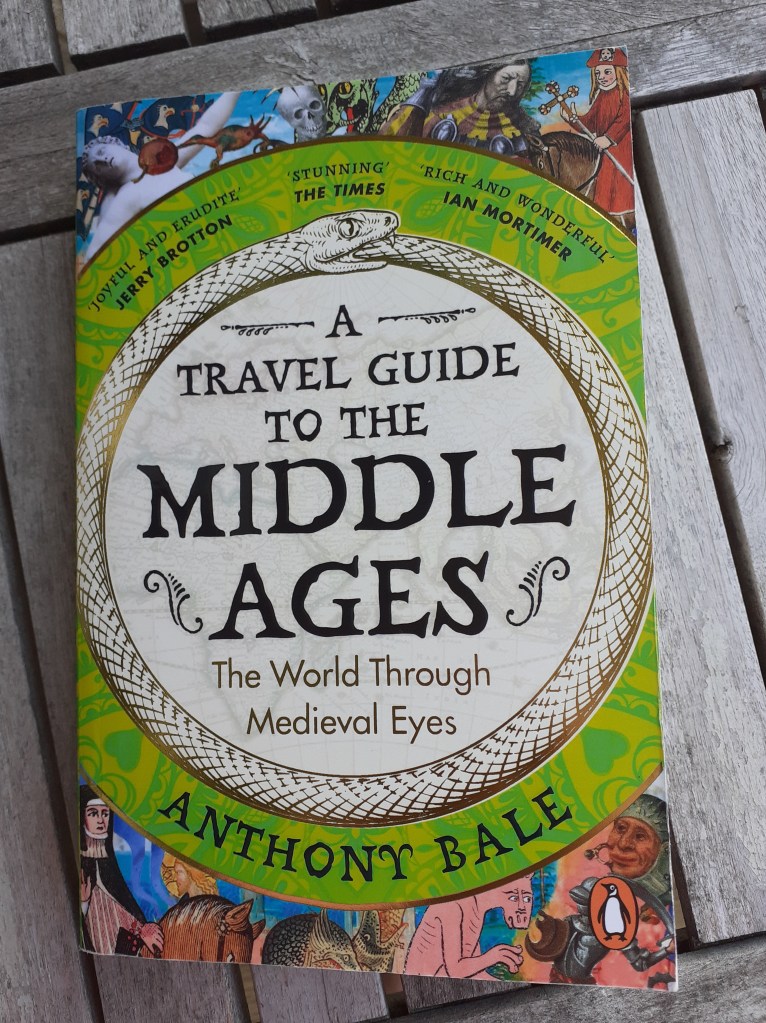
A Travel Guide to the Middle Ages : the World Through Medieval Eyes / Anothony Bale
I admit that before picking up this book, my knowledge of the Middle Ages was pretty limited: knights. Plagues. No Netflix.
Thankfully, this book contains a lot of information so I now know much more. It’s dry in the sense that it contains a lot of names, dates and places. But it isn’t written like a lecture; it isn’t boring. It’s written for any knit-wit that wants to learn more, and I was happy to sign up. And sheesh, did I learn stuff.
First of all: there’s not that much difference between preparing for travel back in the Middle Ages and the present day. Bags are packed, money and travel papers set aside, guidebooks purchased.
Of course, last-minute trips to a sunny destination were not what it was about back then, and travel was mostly pilgrimage related. However, travellers back then bought souvenirs, kept track of their adventures, and tried to make sense of new / other cultures, like we still do today. We have stickers or emblems with flags that get sewn onto backpacks, they had patches they wore on their lapels. They bought walking sticks and hats, we buy keychains and t-shirts.
They wrote their names on walls and doors of sites they visited, we…well, that one hasn’t changed a bit.
They kept diaries and wrote books on their findings (or made them up completely), we blog, tweet, and post (heavily edited or not) on Instagram.
And mass tourism is nothing new: back then, people travelled in caravans of up to thousands of pilgrims through the Holy Land.
The book is set up like a trip: it starts with a chapter on preparations, then there are the actual travel chapters, and it ends with a chapter on homecoming.
Great care has gone into making the reader understand the time and place. For example, referring to the Holy Land nowadays for Christians means Israel. But, back then, it meant any land mentioned in the bible, leading to a geographical area that included what are now Cyprus, Syria, and Egypt.
And while this book isn’t about pilgrimages but travel in general, pilgrimage was the biggest reason for regular people (non-soldiers, non-crusaders) to travel. Therefore, there are a lot of biblical references, especially in the first half of the book. But, the book also touches on the other travel patterns: south into northern Africa, and the Silk Roads east. Of course, this is because the second biggest reason to travel, was trade.
Almost everything in this book is based on western European perspectives, with one chapter offering a glimpse into the view from “the other side”. (Spoiler alert: aside from the travel direction there wasn’t much of a difference.)
The author cites from travel books, diaries and (auto)biographies of the time and I like to imagine that this means he got to visit libraries and archives and spent copious amounts of time in them, with these manuscripts in front of him. Which is as close as we can get to time travelling. I’m only slightly jealous.
Non-fiction reads different from fiction and even though the book in pocket only comes down to 360 or something pages, it was slower goings than “normal” with so much information to digest. But I liked this book a lot and I learned so much on this pretty random topic.
This book is for anyone who is open-minded and eager to learn something. If you’re into history, travel, and/or the Middle Ages, that’s an added bonus.
 Bookworm in the City