No. 9: A book set in my country
Waar ik liever niet aan denk / Jente Posthuma
(translated as: What I’d rather not think about)
This book was published back in 2020 but I only learned about it when it was shortlisted for the Booker International 2024. Go figure. I wasn’t the only one because I immediately went to make a reservation in the library and received a notification saying I was number five in line. It was so worth the wait.
This book is the story of a brother and sister. They call themselves One (brother) and Two (sister), after their birth order. They are twins, and have always been close. But the brother doesn’t want to live and takes his own life, and the sister can’t figure out life without him.
Two tells the story and it’s a story of twins growing up in a village, before moving to the big city. Like no names are given, no locations are either. It’s all neutral but still easy to picture.
Two has a dry and dark way to describe her upbringing, for example not recognizing their father walking out on the family, and dying shortly after, as a traumatic event because it wasn’t as serious as surviving a concentration camp would have been. (She’s slightly obsessed with concentration camps and Joseph Mengele (who in turn was obsessed with twins).)
As adults, One and Two start to carve out their own paths although they end up living on opposite ends of the same park remaining physically close. It is One who starts to take more distance though, needing space: he refuses to travel to New York, even though they have planned to visit their aunt who lives there, and prefers to spend time with a chosen family of fellow gay people over his blood relative. One fails his interview for graphic design studies, can’t figure out what it means to be happy, and has difficulty maintaining meaningful relationships. Two’s at times awkward responses, don’t help.
These are two people who are similar and grew up close, but still don’t understand each other as adults.
It’s when One’s depression grows deeper that they become closer again and Two spends more nights with her brother than her husband, not wanting him to be alone. But when someone wants to die, they find a moment and a way.
One’s death leaves Two completely at a loss. Although aware of the strain it’s putting on her marriage she still ignores her husband and spends even more time at One’s apartment than at her own, reading his diaries over and over, trying to figure out what drove him and what she could have done differently. Not knowing how to move on, she slowly comes to a standstill.
The setting of the book doesn’t involve windmills, tulip fields, or gabled houses lining pretty canals. It even takes a while for it to be explicitly clear that this is set in the NL. It’s subtle with the occasional bike ride, or swim in the canal. It’s very Dutch in its directness and straightforwardness though, and, completely fitting the story, the most Dutch thing in it is the way One ends his life.
This book is just like its cover: void of unnecessary adornments. The stripped back style makes it easy to read despite the heavy subject, and the unexpected funny parts offered both relief and sadness. I felt that the style complimented the subject and it completely sucked me in.
Grief, depression and suicide are not subjects for everyone, but this was so beautifully done that I still am recommending the book to anyone who is open to it.
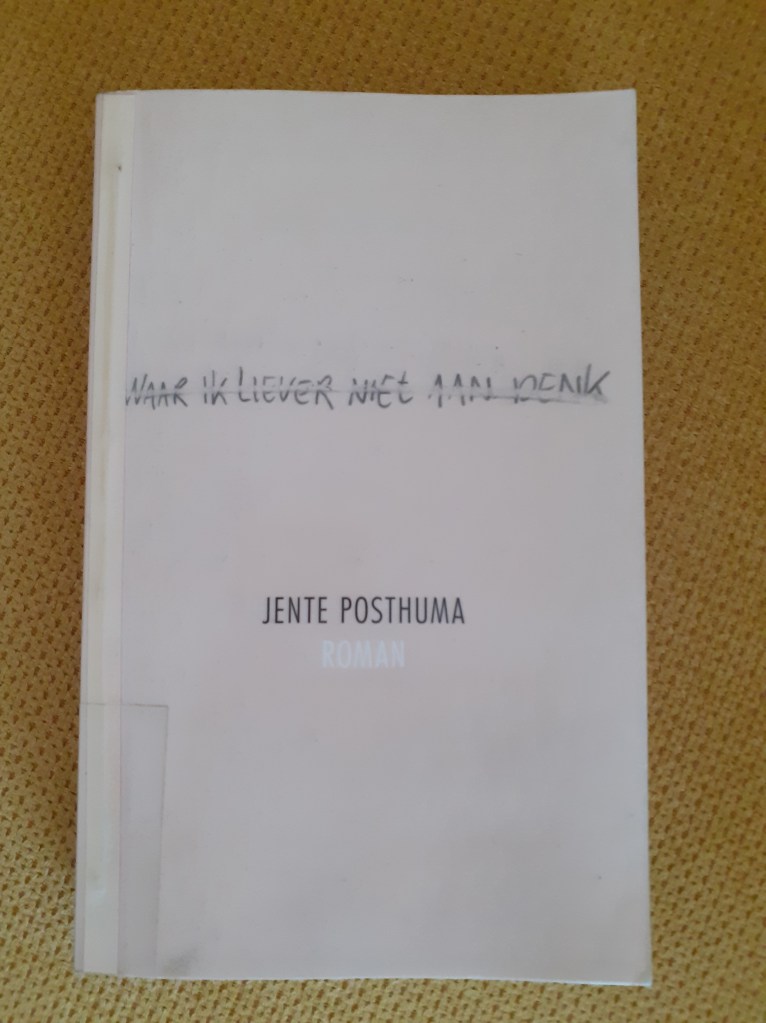
(translated as: What I’d rather not think about)
 Bookworm in the City