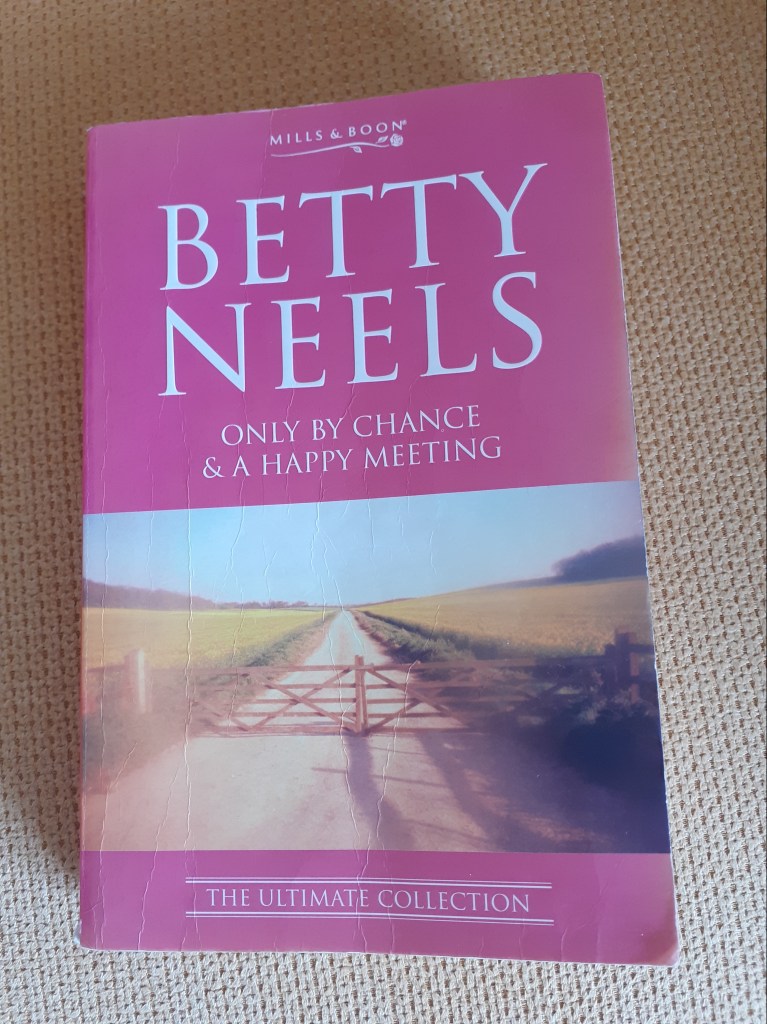
(The Ultimate Collection, volume 3) / Betty Neels
Oh boy. Put your seat in an upright position and brace yourself, because this book is a lot and I have a lot to say about it.
I picked this book from the hotel library during a recent holiday. The reason I picked it, was because it was one of few in English, it was clearly well-read, and it seemed ridiculous. I was in the mood for ridiculous, and did this book deliver!
The book contains two stories, which were originally published in 1996 and 1992 respectively, but collectively re-published in 2002 as part of the Ultimate Collection, after the author’s passing. From the introduction I learned that the author was writing until in her nineties and apparently, she had a large following of fans. I’m glad for this lady, and the success she had and I don’t mean to offend her or any of the many fans, but, oof, is this some painfully old-skool stuff! These two particular stories are Cinderella themed romance novels that manage to not be romantic at all. I feel like the author got stuck in an earlier period of time, as the stories felt so old and dated. At one point I even went back to the title page to check the year of publication because I thought I must have misread.
Not only did I pick a book for myself, but gifted one (review available here sometime soon) to travel companion friend P. We spent two evenings reading out lines of ridiculousness to each other, and even attempted to create a mix-and-match story by knitting the two stories together. Although that didn’t work, it was funny enough to have us in – wait for it – stitches.
The first book in this bundle is called Only By Chance (1996).
The heroine in this is Henrietta, an orphan goodie-two-shoes who is “definitely not pretty”, poor, and basically living in squalor in London’s East End. She has to work three jobs to make a living: part-time at the hospital, as an office cleaner on weekdays in the early mornings, and on Saturdays at a market stall. She has two rescue cats, because of course. It’s so Dickensian.
Then she gets sick and is brought to the clinic for poor people by her landlady and the greengrocer. Adam Ross-Pitt is the doctor on call and recognizes her from the hospital where he also works. He’s a neurosurgeon but also works at the clinic (that he helped co-found), to help the less fortunate, donating large sums of money anonymously, and devoting his time. Obviously, he’s the Hero.
He diagnoses Henrietta with the flu, and because he knows her and learns she has no family to take care of her, he brings her home. As he climbs the stairs while carrying her all the way up to the attic, his “magnificent nose” picks up the scent of boiled cabbage. (This had me laughing out loud, and the term “magnificent nose” became a running gag during the remainder of the holiday because how could it not?)
Later on, the doctor puts his “great brain” to work, and it’s mentioned that he’s got “big feet”. All descriptions of the man are positive, or in a way to describe him as a wonderful specimen. Descriptions of Henrietta though, are solely negative. She’s “plain” and “not pretty” (this is mentioned several times), she has “mousy hair” and wears “drab outfits”. Her innocence is considered “naïve”.
In any case, the doctor pays the landlady to take care of Henrietta, and buys her groceries when he finds out that the kitchen cabinets are near-empty. I feel let down by every doctor I’ve ever had to see.
Fearful that she’ll lose her jobs, Henrietta goes out to clean two days later even though she’d not recovered yet, and when the doctor witnesses her nearly collapsing on the road, he picks her up and takes her to the hospital. As a result of her hospital stay, she actually does lose all her jobs, and gets evicted. I thought this was a bit much given that she only stayed at the hospital for a few days, not a few months, and this wasn’t set in the 1890s but 1990s. Still, the doctor feels guilty about all of this and when he’s attending a party in his hometown in the countryside, the lord and lady of the local manor mention that they are looking for new help. So, he tells them he knows someone, drives to London to pick up Henrietta and her few belongings, and drops her and her cats at the house where she becomes one of the many members of staff.
The staff at the manor, the people of the village, everybody knows that Mister Ross-Pitt is a catch: after all, he’s a doctor with a magnificent nose and large feet. (I kept reading these descriptions as euphemisms but have a feeling they weren’t meant as such because it was all a tad too serious for that.) Of course, such a catch is being chased: there’s a woman who is set on marrying him and she’s described as wearing glamorous outfits and being mean to people “below her standing”. This Deirdre is the evil stepsister to Henrietta’s Cinderella: she’s the opposite of plain and patient, saintly, Henrietta. Until it turns out that Henrietta isn’t such a saint after all: she expresses to hate Deirdre after their first meeting, which I thought was a bit of a strong emotion, only because she’s in love with Mister Ross-Pitt herself. It’s called jealousy, Henrietta, and it’s not a good look on you. Also, she keeps referring to him as Mister Ross-Pitt. In fact, the story and everybody in it, refers to him as Mister Ross-Pitt up to the point where I actually forgot his first name. This again struck me as such an old-fashioned thing, although, I was willing to accept that the story takes place in British upper class and it involved different social standings.
What else to say about Henrietta. She’s supposed to be in her twenties yet wears a scarf to cover her hair like older women do/did. When she goes shopping, she buys pleated skirts and cardigans, and a beige coat that is “nothing special”. She’s twenty-something going on sixty.
Everybody loves Henrietta, because she’s such a hardworking, sad, and modest girl.
They all think the doctor should choose Henrietta over Deirdre but the doctor is blissfully unawares and only considers Henrietta a friend at most. Then all of a sudden realization hits (I can’t remember why) and he knows he loves her but can’t properly communicate that and instead treats her awkwardly bad, is rude and curt with her. Eyeroll.
Then he does start referring to Henrietta in thought as “his Henrietta” and there is a weird moment where he walks up to her and out of nowhere kisses her. Because Henrietta thinks he’s about to marry Deirdre, and Adam thinks Henrietta is in love with another man, it only makes things more uncomfortable between them. His great brain definitely wasn’t working, or he would have known to have, you know, a conversation with her. Instead he goes to America to operate on someone important (of course), returns, and asks her to marry him. And yes, it ended as abruptly and oddly as that. I guess distance made the heart grow fonder?
I earmarked pages where truly stupid stuff happens/is said, but there were so many that some pages had to be double-folded because stupid stuff happened on both sides of the page.
It took some time and a lot of liquid courage to get myself started on the second book.
A Happy Meeting. This book has an average of 4.15 star rating on Goodreads. And yes, I was sober when I looked that up. 4.15. So many raving 5-star reviews, from reviewers as recent as last year. I’m dumbfounded.
This book is a carbon copy of Only By Chance. Or rather the other way around, as A Happy Meeting was published first, in 1992. Sad, mousy, and poor heroine. Doctor hero who saves her. Bunch of fancy big homes with lots of staff. Hero is rumored to marry a society girl nobody likes. Hero and heroine have almost no interaction. There are two kisses before the story ends with an abrupt declaration of love and marriage proposal.
This was more like finding the ten differences between the two pictures. The only differences I could find, were in names and locations.
This story starts with heroine Cressida at the side of the road, desperate to flag down a car because she’s twisted her ankle while saving a dog that had been left tied to a tree. (Typical.)
Doctor Aldrik van der Linus saves both her and the dog, takes her home (check the box for carrying her up to her room) and leaves her with instructions to stay off her feet for a few days. Of course, Cressida can’t do that because her mean stepmother is treating her horribly and expects her to prep the house for a dinner party. The pain is too much for Cressida, who faints. (Box checked for martyr heroine.)
When the doctor finds out about this, he asks his colleague to have a look at her. That doctor sends her straight to the hospital for x-rays but even though nothing is broken, she is made to stay for a few days, which seemed very over the top to me. (What was happening in English hospitals in the 90s that people got to stay a few days for minor injuries?)
Cressida is “four and twenty” (honestly) and from the way the doctor is described I thought he was well into his forties, but near the end it’s expressed that he’s only thirty-five. Note, it’s not five and thirty for him. Also, Cressida checks herself out in a looking glass instead of a mirror. I think she considers herself a maiden from ye olden times?
Also, again, the descriptions of these two are awful: he’s good-looking, has a great mind, and a “vast back”. (His nose wasn’t magnificent enough to warrant a description though.) She’s “a dab of a girl”, who wishes that she has “even a modicum of good looks”, and has mousy hair.
The doctor describes her as unremarkable, with only nice eyes and a pleasant voice.
Would it be too much to label this self-plagiarism? It’s basically copy-paste.
This also is again a doctor who feels incredibly responsible for someone he’s not responsible for, and goes out of his way to secure Cressida a job. Well, he asks his grandmother to fib about needing a companion. Cressida doesn’t question any of this, is happy to accept and only sad because the doctor is traveling back to The Netherlands where he lives if he’s not visiting his grandmother, saving lives or lecturing wherever else in the world.
This book also has so much confusing travel in it. The doctor wants Cressida to be close enough so he can keep an eye on her (creepy), and he sets up another job for her in the NL. He divides his time between a house in Leiden and in a mansion in the middle-of-nowhere Friesland. He goes back and forth all the time, throwing in visits to other places, friends and family as well. He does this in England too. How he has time left to see patients and teach (all over the world!), and have articles published in The Lancet, I don’t know.
The first job in the NL is actually arranged by the doctor’s evil girlfriend who sets Cressida up for failure. After that, the doctor arranges another job in Friesland with friends of friends of friends. I think. It got very confusing with all the names and places and all the back-and-forthing.
The story is set in autumn and winter, and there’s a big to do about the doctor getting married in the new year. This is only gossip sent into the world by the girlfriend, and nobody bothers to ask the doctor about it. The doctor by then has realized that he cannot continue seeing this woman, but doesn’t do anything to silence the rumors, which causes unnecessary drama. Also, the doctor has spent Christmas with his grandmother in England, and Cressida is super peeved that he hadn’t bothered to send her a Christmas card. He got her medical care and jobs, and now she also wants a card?
There’s a lot of weird action in the last twenty pages or so, with a strange accident in Friesland that sees both Cressida and the doctor come to the rescue of two friends. After that, Cressida has to suddenly leave for England to save her old housekeeper from possible eviction. She finds out that the house was already sold, and finds out that the doctor is the buyer. Because of course, he’ll help them out and just randomly buys this woman’s house because she’s important to Cressida and what’s important to her is important to him. He professes his love in the solicitor’s office, which makes her smile, and her smile turns her “ordinary face suddenly beautiful”. And that’s the end.
I don’t understand how any of this story is conceived as wonderfully romantic. It being super chaste is one thing, but the characters again are very much leading their own lives and don’t overlap enough for their so-called connection to be understandable. There’s no equality, no sparkling dialogue, no tension or love at first sight to make this believable. Aldrik is rescuing Cressida from a difficult home situation and claims he wants her to be independent, with a job, income, and home of her own. How rustling up made-up jobs for her is doing any of that, is beyond me. She’s still dependent, but just on different people (the doctor and his friends instead of her evil stepmother). They might be meaning well, but it’s not doing anything to improve her situation at all.
Cressida is also not exactly questioning any of these weird twists and turns, and lets herself be picked up and dumped anywhere. She’s not showing any growth, input, or character. She’s as bland as her appearance.
Again, I couldn’t believe this was published in the nineties. It was so old-fashioned and just doesn’t hold up for me. Although I wonder if it held up even back then. Of course, it being Cinderella themed doesn’t help either because that story itself suffers from a very passive heroine and cardboard hero (can’t even remember his name?). I need to dive into the Mills and Boons genre more for some much-needed comparison and perspective because this publication managed to get me intrigued. For all the wrong reasons, but intrigued nonetheless. Suggestions for titles are welcome. To be continued for sure.
For now though, I’m just so, so, done.

 Bookworm in the City
Hahahahahahahahahahahahahahah…this is funnier that a subterranean parking lot on Huelva
LikeLiked by 1 person
That parking lot was magnificently scary though.
LikeLike