No. 3: A book that is set in the 70s
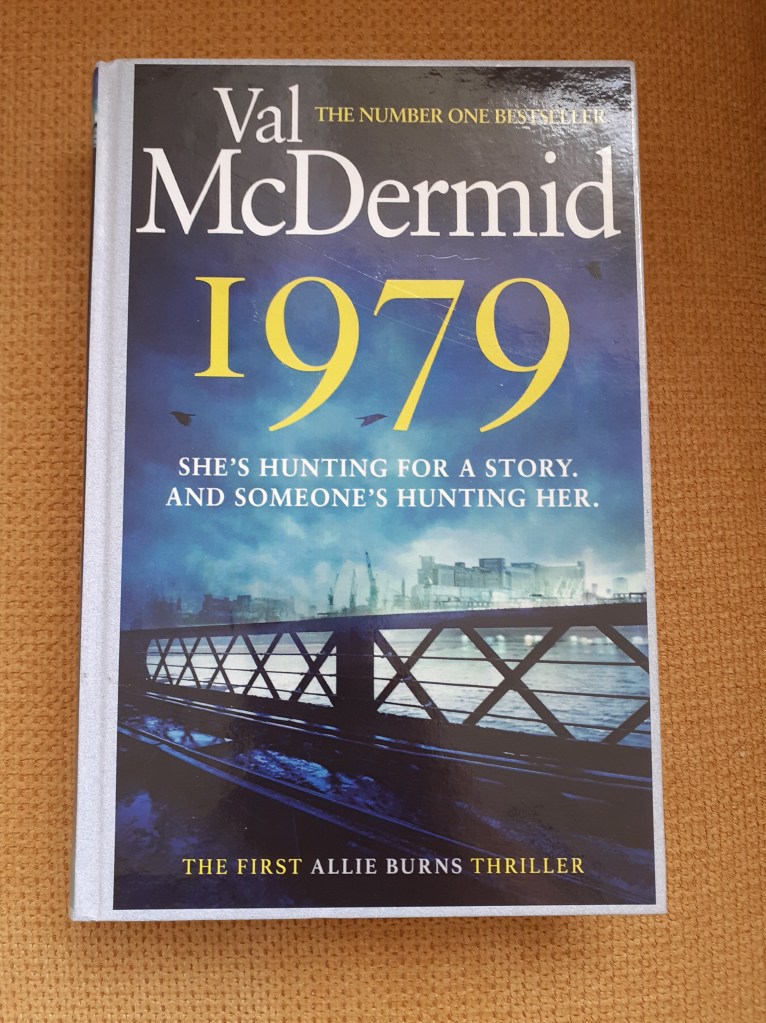
1979 / Val McDermid
Another challenge category for which I resolved to my earlier method of browsing shelves and randomly pulling out books to check their time setting. Then this title jumped out at me and I thought it’d be a solid bet that this would fit. And does it ever.
Starting right at the beginning of the year 1979, we meet main character Allie Burns on the way home to Glasgow after spending New Year’s with her parents. On the train she meets Danny, who is a fellow reporter with the Clarion newspaper. Along the way they stumble into a story, and the collaboration propels them from co-workers to friends, confiding in each other and assisting each other on other stories. They are both outsiders at work, and connect over that. They both hustle to find stories and get them printed. When Danny starts a proper investigation in a money laundering scam, he gets Allie involved for fresh perspective and help with the writing. When Allie starts an investigation into radical politics, she in turn asks for Danny’s help because as a man he can get closer to one of her sources.
What this book does really well is characters and setting of scenes.
The big difference with the book that was set in the 80s, is that that one felt very focused on describing the time period, especially in the first few chapters, almost as if it was describing for describing’s sake. Every item was described, from the orange foam of the headset of a Walkman, to the wood paneling of a car, and at times it felt like it was done with a lens of nostalgia, rather than befitting the characters.
1979 sets the scene from a story perspective and you still get the same sense of time anyway simply through Allie’s point of view: people smoking everywhere, including in the office, the dings of typewriters being used, and the use of carbon paper for instant copies. She needs a roll of film for her camera, has Italian food for the first time at the one Italian restaurant in Glasgow, calls are made from phonebooths, and Allie and Danny know their way to the library where they frequently use the reference section.
That the book is set during the 70s is also noticeable in the cultural references (the music playing in the background, the shock of an ABBA divorce), and the sexism and homophobia that are rife everywhere, not least in the workplace. (Being gay was still punishable by law in Scotland, so no wonder people were deep in the closet.)
The workplace set-up was really well done, and Allie’s struggle of being a newbie and a woman in this journalism world, was believable. The ending came on so sudden though, that it left me staring at the book for a hot second, realization slowly hitting that I was actually done, even though I was only three stops on my metro ride in, and now had nothing left for the rest of the way.
The reveal was through an epilogue in form of newspaper clippings, which was a nice touch, but didn’t feel like a proper, smooth, ending. Maybe that’s because this was the first book of a series, as it felt so open-ended.
The author provided a playlist as an extra which I really liked as it contributed even more to the vibe of the time setting.
Based on the art and text of the cover page, I figured this would be a nail biter of a book. It wasn’t, and things only picked up pace at page 300 or so, and then it still lacked tension so it wasn’t scary or thrilling. I also just don’t think it is a correct way to sum up the story because spoiler alert: at no time is Allie “being hunted” or in danger.
Because I’m a scaredy cat I rarely read scary or gore, so on the one hand it was a relief this book wasn’t too scary but equally a disappointment. Those first 300 pages were more (cozy) mystery at best than anything else, and I had braced myself for something…more. This reading experience for me was like taking a sip of what you think is going to be vodka but turns out to be water. Still okay, but not what I expected.
In conclusion: a solid fit for the category, but not the thriller it promised to be.
 Bookworm in the City