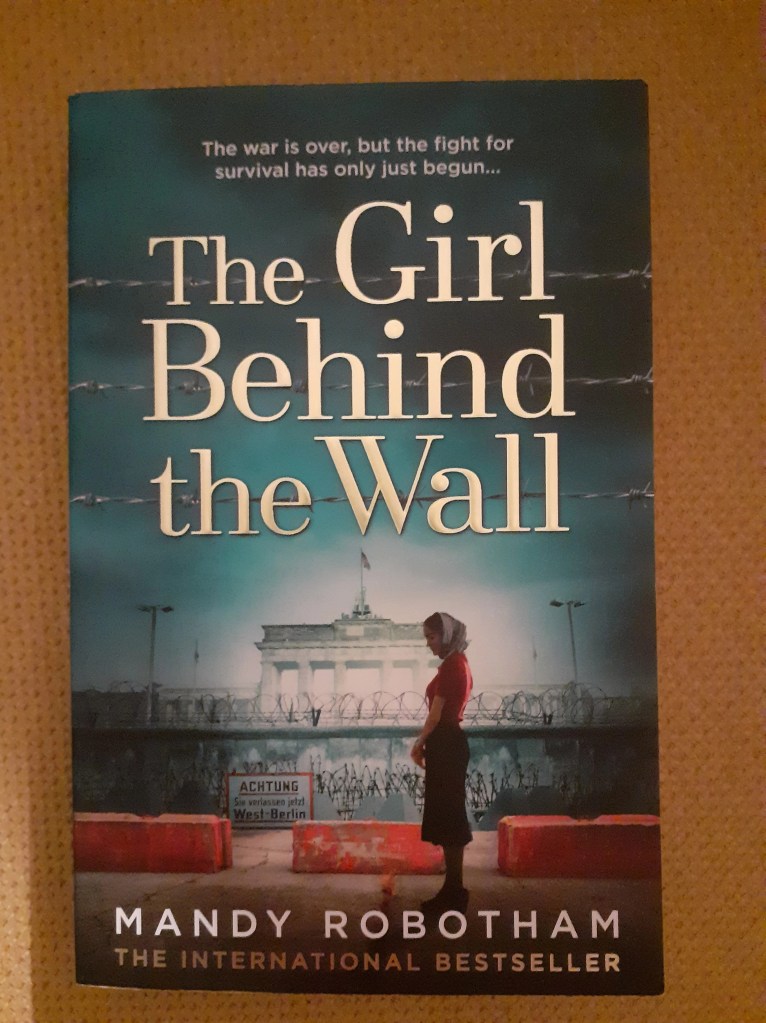
This story starts on August 13, 1961. And if your history isn’t sharp on what happened that day, the first page gives it away: Berlin wakes up to a wall rising on its border.
The border had been there drawn in chalk, but suddenly there was a construction going up.
The only people still allowed to cross the border, were military personnel, and foreign press:
everybody else is stuck where they are. This is problematic for Karin, a young woman from West Berlin, who was taken to hospital in East Berlin the night before. She wakes up with her appendix out, and a border up. Her twin sister Jutta, is on the other side, at home with the family. Their cousin Hugo is a radio reporter and he takes Jutta along with him to cover the development of the newly rising border blockade, while trying to find a passage still open. There is none. The best they can do, is find a member of the foreign press and ask them to bring a note to the hospital.
In the days and weeks that follow, the Wall only goes up higher, and the strips of no-mans-land are becoming more fortified. It quickly becomes clear that Karin is trapped behind the Wall. It becomes Jutta’s mission to get her out.
The story goes back and forth between East and West Berlin, Karin and Jutta.
The chapters are short, which keeps the pace going. It also does a great job in describing daily life in the city at the time, and the differences between the two parts.
When Jutta accidentally stumbles onto a hole in the Wall, she goes through it, and locates her sister. She figures that Karin will be eager to come home with her, but Karin is settled into life in East Berlin by then: it’s been almost two years and she’s got her own apartment, a job, friends, and a man she loves. A man she loves so much, that it’s impossible for her to run and go home. Jutta tries to convince her that life in the West will be better, but Karin needs time. So, the sisters settle into a routine with Jutta regularly traveling through the Wall, to meet her sister for an afternoon. The fact that they made it undetected once, even twice, is a miracle. To think that they will remain invisible and keep this up, is a naïve gamble.
The start of the story has a lot of action: the Wall goes up, the scene is set. But then it stagnates. While that helps to describe how life assumes a new normal even in such a situation, this part of the story felt disproportionately long compared to the beginning and end. Because it isn’t until page 340 that pressure starts to build, and for a book that has 393 pages (including an epilogue) that was a bit late.
The two sisters are equal on paper, but Jutta was front runner for main character for me. She’s the one that goes through the Wall, she’s the one that realizes there is a sense of urgency. Karin felt too meek, too passive, and while her indecisiveness was understanding, it also got annoying, probably because it took too long, and it didn’t seem like she understood that she couldn’t take forever to make up her mind. Not making a decision, is a decision itself, and it got to a point where I thought Jutta should just leave her be, and move on. I don’t think that’s what I was meant to feel.
In the end, reality catches up with the sisters, and in a very bad way. But just as things are speeding up again, the story suddenly ends with a cliff-hanger.
The reveal happens in the epilogue which takes place on 11 November 1989 with the fall of the Wall. Having started the story with the rise of the Wall, that is a nice way to bookend things. But it felt hasty, as if space had run out, and this was the only way to wrap things up. The ending also felt a bit too neat.
Overall conclusion: this is an okay read, but for me it was on the verge of “meh”. It’s solid because of the obvious research that was done to provide a good setting, but a story is more than its setting, as it needs good characters as well. The characters in this book could have used a bit more oomph.
 Bookworm in the City