No. 10 – A retelling of a classic
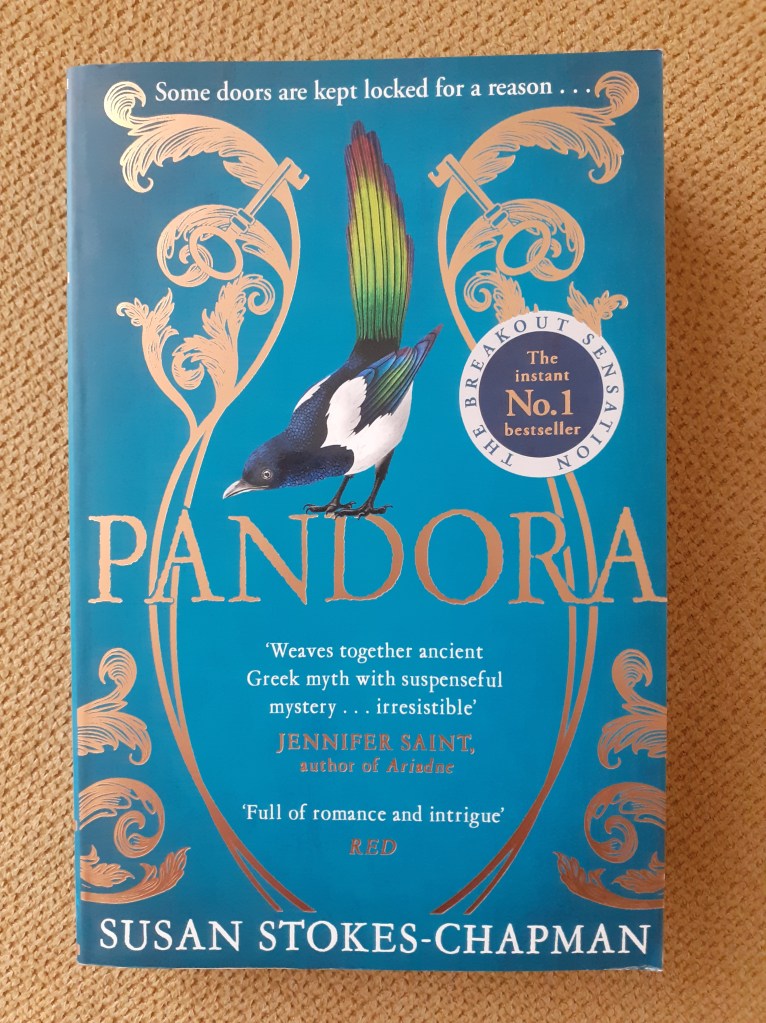
Pandora / Susan Stokes-Chapman
Well, it happened again. First, I wanted more Australian authors and promptly read three in a row. Then, I asked for more not-your-typical animal sidekicks et voila: Pandora delivers me a pet magpie.
I guess I should think of other reading wishes to come true but I don’t want to be too greedy.
And first things first: this retelling of a classic.
I didn’t learn about the Greek classics in school, and only know some of the Greek and Roman mythology from doing crossword puzzles. All I know of Norse mythology, is with thanks to the Marvel movies. A few years ago I decided to dive into the subject, but honestly, the big books were scaring me off. So, I settled for Stephen Fry’s Mythos to cover the basics. It was a fun read and I learned a lot! I’m not sure if that was the book that set off the flow of modern retellings of those classic stories, or if it was just part of the early wave, but since then so many stories based on (mainly) Greek mythology have been published, that I was spoiled for choice for this entry. In the end I settled for Pandora. I’m being honest here and will admit that size of the book was part of its appeal: some of these books are just so big and it was the end of October and with so many items on my reading list still unchecked, I wanted to make as short work of it as possible. This book came in at just shy of 400 pages, so still a decent size.
Main character is Dora. Her full name is Pandora and she was named after the first woman created by the Greek gods. Her mother was Greek and slightly obsessed with the story.
As a child, Dora travelled along with her parents, archeologists, all over southern Europe to dig, and find antiquities, but when she was eight, her parents were killed when a dig site collapsed. She was pulled out of the rubble and shipped back to London with her uncle. At twenty-one she still lives with that uncle, Hezekiah, in the attic above the antique shop he took over from her parents. Lottie is their housekeeper, although she’s mostly Hezekiah’s live-in lover, and both Lottie and Hezekiah have great dislike of Dora. The feeling is completely mutual, and they exist in the same space but that’s about it.
Whenever she has to work in the shop Dora mostly dreams about designing jewelry, sketching her designs in-between tending to the few customers that come in. Hermes is her pet magpie (with an amazing Greek God name), who delivers her the necessary trinkets to use for making mock-up versions of those jewelry designs. Hermes resides either in his cage, or on Dora’s shoulder. The two have an incredible bond, and honestly, it’s changed my opinion of the birds a bit (their caw is just something that’s not my favorite sound in the world).
Dora is aware that Hezekiah is mostly conning his customers by selling forgeries, but doesn’t care enough to stop him or warn the customers. The story takes place in 1799 which means that as a woman without other family, she is completely reliant on him and cannot afford to rock the boat.
Then there’s Edward, who very much needs to rock the boat if he ever wants to get accepted into the Society of Antiquaries. So far, his attempts to get in have not been received well and he’s been told to come with something strong, something truly interesting.
When Dora finds out that Hezekiah is hiding a magnificent vase in the basement and is being incredibly secretive about it or its origins, she sets out to discover if it is another forgery, or the real deal. For this, she needs someone with an expert eye, and she finds her way to Edward. For Edward, this is a win-win: if the vase is real, he’s got an incredible subject to write about. If it’s a fake, his subject will be forgeries, which will still be interesting enough.
Edward has a dark past that results in him suffering from claustrophobia and a fear of the dark, so working in the dark and damp basement of the shop in the middle of the night, is not within his comfort zone. However, he’s aware that they have to sneak around Hezekiah, and this is the only time and place available for research. So, he confronts his fears and gets to it.
Edward’s benefactor and best friend, is Cornelius Ashmole, an idle gentleman and delightful grudge. The first half of the book I kept misreading his name as Asshole which seemed fitting because Cornelius doesn’t hide the fact that he is suspicious about Dora’s motives and does not like that Edward is so committed to the research.
The moment Edward and Dora start to ask around about the vase and its origins, it sets a series of events in motion and I kept wanting to remind them about the story of Pandora’s box, thinking these two should know better. There’s a hint of the mystique surrounding the story, befitting of the myth.
The way the characters and their environment are described, is so vivid and clear, that it all easily comes alive. It also fits especially the two main characters, Dora and Edward, who have observant personalities, and spent most of their lives living in the background.
With books like this, you don’t need a time machine. (Also, it kind of puts you off time travel, because the way the stink is described…oof, I feel I can do without that experience in person.) Every character in this book has motives, reasons for their behavior, even if they’re not immediately clear. The characters also aren’t perfect and have flaws, but they grow and develop, and it makes them all the more real. Nobody is just grumpy, or mean.
This is a Greek myth, wrapped in a Dickensian story. Strange as that might sound, it totally works. I don’t know enough about the Greek myths to know if I missed references, names or the likes, but I was too immersed to care, and even without knowing, this book was a great read.
 Bookworm in the City
One thought on “Reading challenge 2023 – No. 10”