No. 15 – A book with food in the title
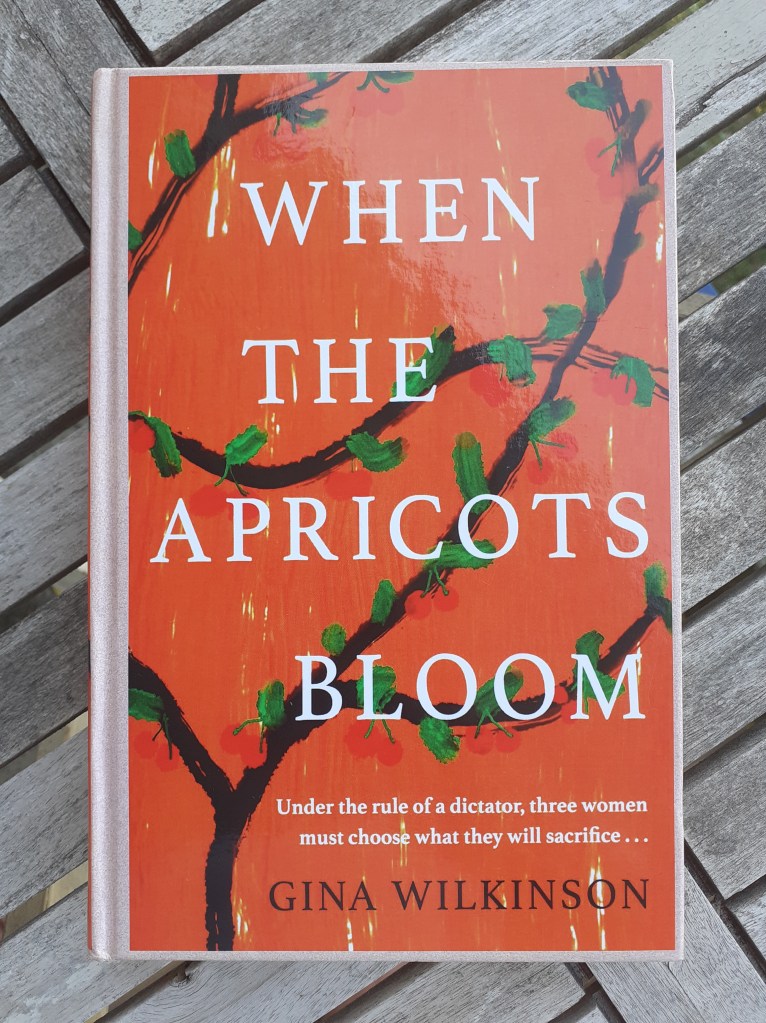
When the apricots bloom / Gina Wilkinson
Aaaand here’s the third book by an Australian author in a month. It’s like the secret: if you believe it, it will happen. It should probably freak me out a little bit, but I’m just too happy with it to question it, so onto the challenge.
This challenge entry proved a difficult one, because I kept overthinking it but then I realized that in my mind I had turned “food” into “meal” and of course that’s not the same. So, I decided to stick to what border security says in those real-life docuseries: if you can eat it, it’s food and you should have checked the box on your papers. It left me browsing the library shelves for edibles (so to speak of course) and I took this book out without even checking what it was about.
It turned out that When the apricots bloom is a modern historical novel that takes place in Baghdad, 2002, and is inspired by the author’s experiences in Baghdad.
The story centres on three women. Huda and Rania were childhood best friends but an incident drove them apart and they moved on, got married, and raised families. Their lives are brought together again with the arrival of Ally, a young newlywed who followed her diplomat husband to his new appointment at the Australian embassy. Huda works at the embassy as a secretary and although the pay is great, the downside is the secret police, who are keeping close tabs on her because she works with foreigners. They push her for information and when they feel she’s not getting enough for them, threaten to draft her son into the horrible fedayeen.
Out of desperation Huda contacts her old friend Rania who, as the daughter of a sheikh, has connections that Huda is hoping to use to get her son a passport so he can escape the country and live in safety abroad. Rania, however, has problems of her own: broke, and forced to draw art for Saddam Hussein’s Ministry of Culture, she cannot afford to rock the boat.
Ally, in the meantime, is having a hard time adjusting to life in Baghdad where her “housewife” visa doesn’t allow her to do anything more than that. A journalist by training though, curiosity keeps drawing her out and she starts investigating the past. Her mother had been a nurse and worked in Baghdad in the seventies. Although her mother passed away when Ally was young, she left pictures and postcards behind and Ally wants to find her mother’s old friends and learn more about the time she spent in the city. The seventies were a very different time though and one not a lot of people are willing to talk about, especially because Ally goes about it like a bull in a china shop: although she is aware of the secret police listening in on her calls and conversations, she doesn’t realize that local people are also under their control, and she is endangering any person she talks to simply because they are seen in the company of a westerner.
The women are brought together by fate and realize that they need to trust each other to make it out alive. But trusting someone you know has lied and betrayed and is keeping secrets, is not easy.
As it is said: “two people can keep a secret, when one of them is dead.”
The anxiety of being watched at all times, the whispers, the dread of not knowing who is an informant and who can be trusted, is well-written and makes the book a page-turner.
Not having read any other books set in this country at this time, I’m really glad I picked up this book and let myself be surprised.
 Bookworm in the City